
Category Archives: Education

Hidden Racism of Charter Schools

There was an article in the St. Louis Post-Dispatch today, "Some St. Louis charter schools worry their popularity threatens diversity". The article stated, "A few of the city’s charter schools are becoming so popular that they’re struggling to stay accessible to low-income families." On the surface, this may seem like some innocent accident, but it may have been part of the design.

The easiest way to hold back or control a group is people is to control their education. Just as Southern slave owners understood that denying slaves an education reduced the capacity of slaves to think, substandard education reduces the capacity to do for yourself and increases reliance upon others. See our Educational Oppression page.
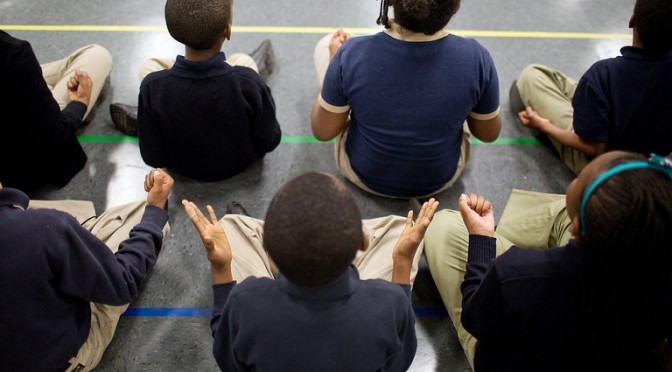
The St. Louis Public School System has and will continue to decline. In the late 1980s and early 1990s, I taught in the St. Louis Public Schools. Even then, you could see the games being played with the desegregation program.

Many of the best and brightest black students were being taken out of the city system and the county was transferring some of its poorly performing or trouble maker white students into the city system. Hundreds of millions of city school dollars ended up going to county schools which helped pay for modern facilities and amenities. The obvious results were declining enrollment, older facilities in disrepair and lower student performance which opened the door for charter schools.

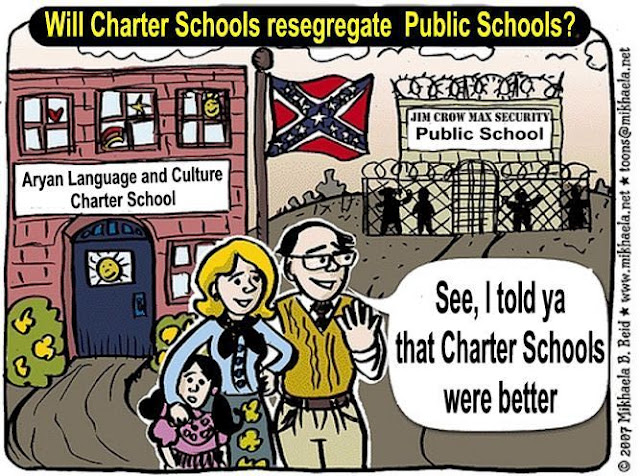
Charter schools stripped, even more, dollars from the public school system and were not accountable in the same ways as public schools since they were considered independent even though they were funded with public education funds.

Below you will find excerpts and links to three different sources that make a pretty good argument for the racist nature whether planned or unintentional.

The Racist History of the Charter School Movement

The now-popular idea of offering public education dollars to private entrepreneurs has historical roots in white resistance to school desegregation after Brown v. Board of Education (1954). The desired outcome was few or, better yet, no black students in white schools. In Prince Edward County, Virginia, one of the five cases decided in Brown, segregationist whites sought to outwit integration by directing taxpayer funds to segregated private schools.

Two years before a federal court set a final desegregation deadline for fall 1959, local newspaper publisher J. Barrye Wall shared white county leaders’ strategy of resistance with Congressman Watkins Abbitt: “We are working [on] a scheme in which we will abandon public schools, sell the buildings to our corporation, reopen as privately operated schools with tuition grants from [Virginia] and P.E. county as the basic financial program,” he wrote. “Those wishing to go to integrated schools can take their tuition grants and operate their own schools. To hell with 'em.”  

Attorney David Mays, who advised high-ranking Virginia politicians on school strategy, reasoned, “Negroes could be let in [to white schools] and then chased out by setting high academic standards they could not maintain, by hazing if necessary, by economic pressures in some cases, etc. This should leave few Negroes in the white schools. The federal courts can easily force Negroes into our white schools, but they can’t possibly administer them and listen to the merits of thousands of bellyaches.” 

NAACP Sounds the Alarm on Charter Schools, Warns of Racist Discipline Policies, Segregation, Lack of Oversight and Accountability

The NAACP, the nation’s oldest civil rights organization, recently passed a resolution at their national convention in Cincinnati calling for a ban on privately managed charter schools.  The resolution said the following:

* “Charter schools have contributed to the increased segregation rather than diverse integration of our public school system.”

* “Weak oversight of charter schools puts students and communities at risk of harm, public funds at risk of being wasted, and further erodes local control of public education.”

* “[R]esearchers have warned that charter school expansions in low-income communities mirror predatory lending practices that led to the sub-prime mortgage disaster, putting schools and communities impacted by these practices at great risk of loss and harm…”

Understanding the “New” Racism through an Urban Charter School

In 2005, a research paper, published by Beth Hatt-Echeverria, a White female assistant professor of Education at Illinois State University and Ji-Yeon Jo, a Korean female independent researcher, discuss a subtle form of racism based uncovered by research conduct at Eagles Landing Charter School. Excerpts from their findings are below.

“There is a charming story by Dr. Seuss…In a society of beings called Sneetches, there were plain and star bellied speeches. The star-bellied Sneetches were the ‘best’ and dominated the plain-bellied folks. Recognizing the injustice of the situation, the oppressed Sneetches decided to paint stars on their own bellies. Now there was equality! But not for long. The original star-bellied Sneetches had their stars painfully removed and claimed, of course, that plain bellies were now marks of superiority. Power structures do not crumble easily.”

Even though there has always been racism in American history, it has not always been the same racism. Political and cultural struggles over power shape the contours and dimensions of racism in any era”. The “contours and dimensions of racism” change as if dancing with civil rights to ensure that White privilege remains the lead dancer. As legislation and policies occur to provide opportunities for people of color, Whiteness shifts to make certain White privilege remains dominant. Giroux (1999) claims that the new shape of racism is a White, conservative backlash to racial minority rights and changing demographics of U.S. cities such as increases in the U.S. Latino population.

As race became paramount in shaping U.S. politics and everyday life from the 1980’s on, racial prejudice in its overt forms was considered a taboo. While the old racism maintained some cachet among the more vulgar, right-wing conservatives, a new racist discourse emerged in the United States. The new racism was coded in the language of ‘welfare reform,’ ‘neighborhood schools,’ ‘toughness on crime,’ and ‘illegitimate births.’ Cleverly designed to mobilize White fears while relieving Whites of any semblance of social responsibility and commitment, the new racism served to rewrite the politics of Whiteness as a ‘besieged’ racial identity.

One of the ways that racism transforms and shifts to maintain White privilege is through the (re)defining of Whiteness as what is “moral” and “normal” in such a way that Whites, especially the upper middle class, benefit.

Eagles Landing Charter School arose from a group of White parents and White educators being frustrated with the local school system. All of the original Board members were parents and teachers connected to one local middle school. A key characteristic of the middle school was that over the past five years it had become more racially integrated. Students of color were beginning to become a majority in the school.

The following statements seemed to be the mantra of the original board members: Class sizes are too large. Too much violence. Too many drugs. Teachers should be allowed more voice. These statements are similar to Giroux’s (1999) description of the new racism as involving coded language that addresses issues of race indirectly by discussions of “Toughness on Crime,” “Welfare Reform,” and “Illegitimate Births.” When interviewing White students, teachers, and parents, the majority of them mentioned some form of the statements above as an explanation as to why they were going to the charter school. Additionally, many of them had left the previously mentioned middle school. On the contrary, many of the African-American students chose to attend the charter school because it was located close to their homes.

Initially, Echeverria and Jo saw the school positively, but then they both felt like the school was almost too perfect. The school staff had maintained some control concerning the student interviews. However, a group of Black students wanted to speak to the researchers without any school staff present. 

For these Black students, the school was not only a very negative experience but it was directly influencing their school achievement. They were experiencing differential treatment, lower expectations by teachers, and alienation. It was the hidden transcript that encouraged us to ask how the ideals and realities were so different in the school and how the teachers and administration constructed their “innocence” in contributing to the experiences of the Black students.


Additional articles:

Charter Schools Propping Up the School-to-Prison Pipeline – US News& World Reports

In Missouri, Race Complicates a Transfer to Better Schools – New York Times

Colonizing the Black Natives: Charter Schools and Teach for America – Seattle Education

School types: The difference between public, private, magnet, charter, and more

Public, Private, Charter, Magnet – What's the Difference?

School-to-Prison Pipeline Complete — New Law Makes Schoolyard Fights Felony

By Justin Gardner

Schoolyard fights now a felony.

On January 1, 2017, the state of Missouri will implement a public school policy sure to accelerate the descent into police state dystopia. See, Missouri Revised Statutes 565.054 and 565.056.

The Hazelwood School District put out a memo to parents and guardians stating that, according to Missouri statute, fights at school or on buses will be treated as felonies — which can result in up to four years of prison, fines or probation.

Dear Parents/Guardians:

We want to make you aware of a few new State Statutes that will go into effect on January 1, 2017, which may have a drastic impact on how incidents are handled in area school districts.

The way the new statue reads, if a person commits the offense of an assault in the third degree this will now be classified as a Class E Felony, rather than a misdemeanor. If he or she knowingly causes physical injury to another person (hits someone or has a fight with another individual and an injury occurs) – one or both participants may be charged with a Felony.

Gone are the days when teachers broke up fights and sent the kids home, calling the parents and perhaps suspending the kid if it was a serious incident. “School Resource Officers” or local cops now arrest the kids and, if there is any perceived injury (an arbitrary judgment), will charge them with third-degree assault – treating children cooped up in school as if they are violent adults on the streets.

What does this mean for students?

For example, if two students are fighting and one child is injured, the student who caused the injury may be charged with a felony. Student(s) who are caught fighting in school, bus or on school grounds may now be charged with a felony (no matter the age or grade level), if this assault is witnessed by one of the School Resource Officers/police officers (SRO) or if the SRO/local law enforcement officials have to intervene.”

It doesn’t stop there. Even attempts or threats to cause harm will be treated as a Class A misdemeanor, which can bring up to a year of prison time. If the assaulted person is considered a “special victim,” a Class D felony can be imposed which can mean up to seven years in prison.

The Free Thought Project has reported on numerous examples of how public schools are increasingly relying on armed cops to carry out discipline, thereby criminalizing the age-old reality of children behaving badly.

This has resulted in the increasingly prevalent phenomenon known as the “school to prison pipeline.”

The Arizona State Law Journal found that over the last three decades, there has been a marked shift in public schools to using law enforcement instead of school administrators and teachers for students violating school rules.

Approximately 260,000 students were referred to law enforcement during the 2011-2012 school year, and about 92,000 students were arrested on school property. Unsurprisingly, these numbers affect disadvantaged minority students the most.

The Center for Public Integrity (CPI) documented disturbing examples of children being subjected to law enforcement, just as a shocking video emerged of a cop brutalizing a teenage girl in the classroom for misbehaving.

”Some police actions involve alarming physical altercations, with kids subdued and handcuffed. Others may be handled without much force. But law-enforcement involvement in school discipline has routinely resulted in kids—some as young as elementary school-age—summoned to court to answer charges that they committed crimes. Frequently, charges include battery or assault in connection with schoolyard fights or disorderly conduct or disturbing the peace at school —issues that some believe should be handled by school officials, not cops.”

The worst state is Virginia, with a rate of 16 students per 1,000 being referred to law enforcement. One school had a shocking 228 students, most between 11 and 14, that were referred to cops. A 12-year-old girl was charged with obstruction of justice for clenching her fist at a cop. 11-year-old Kayleb Moon-Robinson, who is autistic, was slammed to the floor for walking out of class too early, and then was charged with felony assault on a police officer and disorderly conduct.

Other shocking examples include five- and six-year-olds being handcuffed, arrested and booked into jail for throwing temper tantrums. Dress code violations, tardiness, and even passing gas have all led to students being referred to law enforcement.

CPI describes how early exposure to law enforcement and the “justice system” has a devastating impact on the mental health of children, and makes it more likely they will grow up to live all or part of their lives behind bars.

“…prosecuting kids in court for low-level accusations like disorderly conduct and battery is actually backfiring; kids become stigmatized, develop records and often disengage from school. The risk increases that they’ll progress to more serious trouble, especially if core emotional or mental-health or learning problems go unresolved or inadequately treated.”

The Arizona State Law Journal confirmed that incarceration increases delinquency and future involvement in the justice system, and “the official processing of a juvenile law violation may be the least effective means of rehabilitating juvenile offenders.”

“No one should underestimate the negative consequences associated with incarcerating a juvenile, both to our society as a whole and to the youth themselves, which is the end result of the school-to-prison pipeline. Empirical research demonstrates that incarceration produces long-term detrimental effects on youth, including reinforcement of violent attitudes and behaviors; more limited educational, employment, military, and housing opportunities; an increased likelihood of not graduating from high school; mental health concerns; and increased future involvement in the criminal justice system.”

By enacting their draconian new rules, the state of Missouri is completely ignoring science, instead, falling back on uniformed state agents with badges and guns – trained to confront the worst of society – to deal with misbehaving kids in school.

Missouri is ignoring the proven benefits of “restorative justice.”

“Thus, rather than excluding the student from the school community for misbehaving, which potentially can cause resentment, disrupt that student’s educational progress, and lead to recidivism and dropping out of school, one of the primary goals of restorative justice is to integrate the offender back into the school community as a productive member.

In essence, restorative justice practices are conflict resolution tools that involve victims, offenders, and other members of the school community. Using formal and informal conferences, or “circle groups,” victims share with offenders how they have been harmed by the offender’s behavior, offenders have opportunities to apologize to the victims, and, with the help of the victims and the other members of the school community, conference participants devise remedies for the harmful behavior.”

Instead of smart approaches like restorative justice, Missouri is set to plunge its children into a police state nightmare — guaranteeing a long-term rise in prison population and further destroying the mental health of the most vulnerable individuals.


Justin Gardner writes for TheFreeThoughtProject.com, where this article first appeared. Republished here under a fair use exemption.

Congratulation Class of 2016

The son of one my closest friends just graduated from college and will soon be moving to Texas to begin a new career and working towards his masters. Unfortunately, life happened and I didn't get to know my friend's children as well as I would have like to. However, I couldn't have been prouder when I received the graduation notice.

President Obama delivered a moving commencement address at Howard University to the class of 2016.  I'm posting this in honor of my friend's son and to all the graduates of 2016. CONGRATULATIONS! Now go change the world.

Racist Sigma Alpha Epsilon (SAE) Chant

Members of Sigma Alpha Epsilon (SAE), University of Oklahoma chapter, dressed in formal wear while on a bus, were caught on video singing a racist chant. SAE is the first national fraternity to be established in the deep south, it was founded at the University of Alabama, Tuscaloosa, on 9 March 1856 and is one of America’s largest college fraternities. The group reportedly was on their way to a day party to celebrate the fraternity's founder's day.

How many of the members shown in the video or others with similiar views will be future public defenders, prosecutors, judges, government administrators, political office holders or even police officers?

This is why developing information about our legal and justice system is crucial, especially for those that are the targets of this type of behavior. The video below does not bleep out any word and is offensive, also the text of the chant is shown below the video.


Text of chant: "There will never be a nigger at SAE, there will never be a nigger at SAE, you can hang him from a tree, but they'll never sign with me, there will never be a nigger at SAE!"

SAE national headquarters has closed its Oklahoma Kappa chapter and the university president said the university's affiliation with the fraternity is permanently done as a campus group and called for the expulsion of fraternity members. This is the type of swift decisive action that was called for in Ferguson and is to be expected in situations such as this.

Racism and bigotry will remain in our country for a very long time, but when there are no consequences for participating in this type of dispicable behavior, future instances of the same behavior is encouraged and validated.

In contrast, Ferguson, MO in their effort to protect the questionable actions of a single police officer, resulted in million of dollars of property damage, a Justice Department investigation, the firing of several city employees, the loss of their municipal court system and staining their city's reputation to the point where they are now the new face and ground zero for a resurgent national civil rights movement. Even President Obama invoked Ferguson during his speech about the 50th anniversary of "Bloody Sunday" in Selma, Al.