Category Archives: Civil Rights

Civil Disobedience and Protest

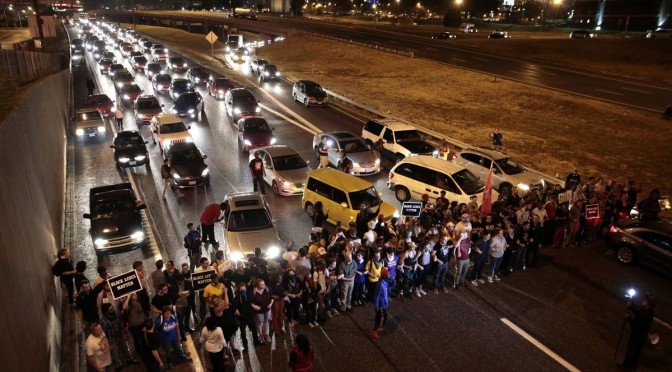
Since the September 15th, Jason Stockley verdict, peaceful protest and civil disobedience have been taking place around St. Louis. The St. Louis protest and the protest during the National Anthem by NFL players have raised questions about protest and the rights of protesters. In St. Louis, activist have blocked streets and highways in protest of police killings.

Is it legal to block traffic during protest? 

No, blocking traffic is not legal. The First Amendment guarantees the right to assemble and the right to free speech and expression; however, there are limits on those rights. Generally, local and state governments can and do restrict the time, place, and manner of protest. Protester engage in civil disobedience when they block traffic. Civil disobedience is the active, professed refusal to obey certain laws, demands, and commands of a government. Although, the process has existed since ancient times, Henry David Thoreau popularized the term with the 1849 essay, "Civil Disobedience".  

For example, in residential areas, reasonable restrictions may be place regarding noise and time. During the first night of the Stockley protest, protesters assembled near Mayor Lyda Kresons home which was vandalized. Even when you agree with the protester's cause, you probably don't want your sleep disturb because people are protesting late at night or early in the moring; at that point protest rights conflict with disturbance of the peace.

In a video below, Martin Luther King Jr. speaks about civil disobedience. 

King stated in his "Letter from Birmingham Jail", "we should never forget that everything Adolf Hitler did in Germany was legal". 


Know Your Rights: Demonstrations and Protests

Compiled from various ACLU documents concerning protest rights

Can my free speech be restricted because of what I say—even if it is controversial?

No. The First Amendment prohibits restrictions based on the content of speech. However, this does not mean that the Constitution completely protects all types of free speech activity in every circumstance. Police and government officials are allowed to place certain nondiscriminatory and narrowly drawn "time, place and manner" restrictions on the exercise of First Amendment rights. Any such restrictions must apply to all speech regardless of its point of view.

Where can I engage in free speech activity?

Generally, all types of expression are constitutionally protected in traditional "public forums" such as streets, sidewalks and parks. In addition, your speech activity may be permitted to take place at other public locations that the government has opened up to similar speech activities, such as the plazas in front of government buildings.

What about free speech activity on private property?

The general rule is that the owners of private property may set rules limiting your free speech. If you disobey the property owner's rules, they can order you off their property (and have you arrested for trespassing if you do not comply).

Is civil disobedience constitutionally protected?

No. Civil disobedience – peaceful, but unlawful, activities as a form of protest – can legally be (and often is) prosecuted. You may be arrested. Make arrangements with a lawyer in advance.

What should I do if I am ordered to disperse?

Missouri’s “Refusal to Disperse” Law is speech protective. No police officer should give an order to “disperse” unless someone is at a “riot” or “the scene of an unlawful assembly” (i.e., “six or more people assemble and agree to violate criminal laws with force or violence”). If you are at such a scene, you must first be given an order to disperse. You must obey such an order. If you do not do so, you may be arrested, even if you are not committing acts of violence.

Do I need a permit before I engage in free speech activity?

Not usually. However, certain types of events require permits. Generally, these events are:

  • A march or parade that does not stay on the sidewalk, and other events that require blocking traffic or street closure
  • A large rally requiring the use of sound amplifying devices; or
  • A rally at certain designated parks or plazas Many permit procedures require that the application be filed several weeks in advance of the event.

However, the First Amendment prohibits such an advance notice requirement from being used to prevent rallies or demonstrations that are rapid responses to unforeseeable and recent events. Also, many permit ordinances give a lot of discretion to the police or city officials to impose conditions on the event, such as the route of a march or the sound levels of amplification equipment. Such restrictions may violate the First Amendment if they are unnecessary for traffic control or public safety, or if they interfere significantly with effective communication with the intended audience. A permit cannot be denied because the event is controversial or will express unpopular views.

Specific problems

If organizers have not obtained a permit, where can a march take place?

If marchers stay on the sidewalks and obey traffic and pedestrian signals, their activity is constitutionally protected even without a permit. Marchers may be required to allow enough space on the sidewalk for normal pedestrian traffic and may not maliciously obstruct or detain passers-by.

May I distribute leaflets and other literature on public sidewalks?

Yes. You may approach pedestrians on public sidewalks with leaflets, newspapers, petitions and solicitations for donations without a permit. Tables may also be set up on sidewalks for these purposes if sufficient room is left for pedestrians to pass. These types of free speech activities are legal as long as entrances to buildings are not blocked and passers-by are not physically and maliciously detained. However, a permit may be required to set up a table.

Do I have a right to picket on public sidewalks?

Yes, and this is also an activity for which a permit is not required. However, picketing must be done in an orderly, non-disruptive fashion so that pedestrians can pass by and entrances to buildings are not blocked.

Can government impose a financial charge on exercising free speech rights?

Some local governments have required a fee as a condition of exercising free speech rights, such as application fees, security deposits for clean-up, or charges to cover overtime police costs. Charges that cover actual administrative costs have been permitted by some courts. However, if the costs are greater because an event is controversial (or a hostile crowd is expected)—such as requiring a large insurance policy—then the courts will not permit it. Also, regulations with financial requirements should include a waiver for groups that cannot afford the charge, so that even grassroots organizations can exercise their free speech rights. Therefore, a group without significant financial resources should not be prevented from engaging in a march simply because it cannot afford the charges the City would like to impose.

Do counter-demonstrators have free speech rights?

Yes. Although counter-demonstrators should not be allowed to physically disrupt the event they are protesting, they do have the right to be present and to voice their displeasure. Police are permitted to keep two antagonistic groups separated but should allow them to be within the general vicinity of one another.

Does it matter if other speech activities have taken place at the same location?

Yes. The government cannot discriminate against activities because of the controversial content of the message. Thus, if you can show that similar events to yours have been permitted in the past (such as a Veterans or Memorial Day parade), then that is an indication that the government is involved in selective enforcement if they are not granting you a permit.

What other types of free speech activity are constitutionally protected?

The First Amendment covers all forms of communication including music, theater, film and dance. The Constitution also protects actions that symbolically express a viewpoint. Examples of these symbolic forms of speech include wearing masks and costumes or holding a candlelight vigil. However, symbolic acts and civil disobedience that involve illegal conduct may be outside the realm of constitutional protections and can sometimes lead to arrest and conviction. Therefore, while sitting in a road may be expressing a political opinion, the act of blocking traffic may lead to criminal punishment.

What should I do if my rights are being violated by a police officer?

It rarely does any good to argue with a street patrol officer. Ask to talk to a supervisor and explain your position to him or her. Point out that you are not disrupting anyone else's activity and that the First Amendment protects your actions. If you do not obey an officer, you might be arrested and taken from the scene. You should not be convicted if a court concludes that your First Amendment rights have been violated.

Can I record or photograph police in public?

Yes.

Can police legally attend a protest undercover?

Yes. And you should be aware that they may try to attend planning meetings to learn about plans for illegal activity.

Can police search demonstrators?

If police have reasonable suspicion that you are involved in or about to commit criminal activity, they can frisk your outer clothing to search for weapons.

Can police search bags and containers without probable cause?

Yes, if you are entering what has been marked a secure area. But you can refuse and should be allowed to leave. Otherwise, police can only search bags if they have probable cause that it contains contraband, weapons or evidence of illegal activity.


For additional protest related information see the following:

 Protester Rights

St. Louis Protest Organizations

Where Protest Fails, Violence Prevails

Protest Minus Disruption or Violence Equals Failure 


Civil Disobedience

By Henry David Thoreau

1849

I heartily accept the motto, "That government is best which governs least"; and I should like to see it acted up to more rapidly and systematically. Carried out, it finally amounts to this, which also I believe- "That government is best which governs not at all"; and when men are prepared for it, that will be the kind of government which they will have. Government is at best but an expedient; but most governments are usually, and all governments are sometimes, inexpedient. The objections which have been brought against a standing army, and they are many and weighty, and deserve to prevail, may also at last be brought against a standing government. The standing army is only an arm of the standing government. The government itself, which is only the mode which the people have chosen to execute their will, is equally liable to be abused and perverted before the people can act through it. Witness the present Mexican war, the work of comparatively a few individuals using the standing government as their tool; for, in the outset, the people would not have consented to this measure.

This American government- what is it but a tradition, though a recent one, endeavoring to transmit itself unimpaired to posterity, but each instant losing some of its integrity? It has not the vitality and force of a single living man; for a single man can bend it to his will. It is a sort of wooden gun to the people themselves. But it is not the less necessary for this; for the people must have some complicated machinery or other, and hear its din, to satisfy that idea of government which they have. Governments show thus how successfully men can be imposed on, even impose on themselves, for their own advantage. It is excellent, we must all allow. Yet this government never of itself furthered any enterprise, but by the alacrity with which it got out of its way. It does not keep the country free. It does not settle the West. It does not educate. The character inherent in the American people has done all that has been accomplished; and it would have done somewhat more, if the government had not sometimes got in its way. For government is an expedient by which men would fain succeed in letting one another alone; and, as has been said, when it is most expedient, the governed are most let alone by it. Trade and commerce, if they were not made of india-rubber, would never manage to bounce over the obstacles which legislators are continually putting in their way; and, if one were to judge these men wholly by the effects of their actions and not partly by their intentions, they would deserve to be classed and punished with those mischievous persons who put obstructions on the railroads.

But, to speak practically and as a citizen, unlike those who call themselves no-government men, I ask for, not at once no government, but at once a better government. Let every man make known what kind of government would command his respect, and that will be one step toward obtaining it.

After all, the practical reason why, when the power is once in the hands of the people, a majority are permitted, and for a long period continue, to rule is not because they are most likely to be in the right, nor because this seems fairest to the minority, but because they are physically the strongest. But a government in which the majority rule in all cases cannot be based on justice, even as far as men understand it. Can there not be a government in which majorities do not virtually decide right and wrong, but conscience?- in which majorities decide only those questions to which the rule of expediency is applicable? Must the citizen ever for a moment, or in the least degree, resign his conscience to the legislation? Why has every man a conscience, then? I think that we should be men first, and subjects afterward. It is not desirable to cultivate a respect for the law, so much as for the right. The only obligation which I have a right to assume is to do at any time what I think right. It is truly enough said that a corporation has no conscience; but a corporation of conscientious men is a corporation with a conscience. Law never made men a whit more just; and, by means of their respect for it, even the well-disposed are daily made the agents of injustice. A common and natural result of an undue respect for law is, that you may see a file of soldiers, colonel, captain, corporal, privates, powder-monkeys, and all, marching in admirable order over hill and dale to the wars, against their wills, ay, against their common sense and consciences, which makes it very steep marching indeed, and produces a palpitation of the heart. They have no doubt that it is a damnable business in which they are concerned; they are all peaceably inclined. Now, what are they? Men at all? or small movable forts and magazines, at the service of some unscrupulous man in power? Visit the Navy-Yard, and behold a marine, such a man as an American government can make, or such as it can make a man with its black arts- a mere shadow and reminiscence of humanity, a man laid out alive and standing, and already, as one may say, buried under arms with funeral accompaniments, though it may be,

"Not a drum was heard, not a funeral note,

As his corse to the rampart we hurried;

Not a soldier discharged his farewell shot

O'er the grave where our hero we buried."

The mass of men serve the state thus, not as men mainly, but as machines, with their bodies. They are the standing army, and the militia, jailers, constables, posse comitatus, etc. In most cases there is no free exercise whatever of the judgment or of the moral sense; but they put themselves on a level with wood and earth and stones; and wooden men can perhaps be manufactured that will serve the purpose as well. Such command no more respect than men of straw or a lump of dirt. They have the same sort of worth only as horses and dogs. Yet such as these even are commonly esteemed good citizens. Others- as most legislators, politicians, lawyers, ministers, and office-holders- serve the state chiefly with their heads; and, as they rarely make any moral distinctions, they are as likely to serve the devil, without intending it, as God. A very few- as heroes, patriots, martyrs, reformers in the great sense, and men- serve the state with their consciences also, and so necessarily resist it for the most part; and they are commonly treated as enemies by it. A wise man will only be useful as a man, and will not submit to be "clay," and "stop a hole to keep the wind away," but leave that office to his dust at least:

"I am too high-born to be propertied,

To be a secondary at control,

Or useful serving-man and instrument

To any sovereign state throughout the world."

He who gives himself entirely to his fellow-men appears to them useless and selfish; but he who gives himself partially to them is pronounced a benefactor and philanthropist.

How does it become a man to behave toward this American government today? I answer, that he cannot without disgrace be associated with it. I cannot for an instant recognize that political organization as my government which is the slave's government also.

All men recognize the right of revolution; that is, the right to refuse allegiance to, and to resist, the government, when its tyranny or its inefficiency are great and unendurable. But almost all say that such is not the case now. But such was the case, they think, in the Revolution Of '75. If one were to tell me that this was a bad government because it taxed certain foreign commodities brought to its ports, it is most probable that I should not make an ado about it, for I can do without them. All machines have their friction; and possibly this does enough good to counterbalance the evil. At any rate, it is a great evil to make a stir about it. But when the friction comes to have its machine, and oppression and robbery are organized, I say, let us not have such a machine any longer. In other words, when a sixth of the population of a nation which has undertaken to be the refuge of liberty are slaves, and a whole country is unjustly overrun and conquered by a foreign army, and subjected to military law, I think that it is not too soon for honest men to rebel and revolutionize. What makes this duty the more urgent is the fact that the country so overrun is not our own, but ours is the invading army.

Paley, a common authority with many on moral questions, in his chapter on the "Duty of Submission to Civil Government," resolves all civil obligation into expediency; and he proceeds to say that "so long as the interest of the whole society requires it, that is, so long as the established government cannot be resisted or changed without public inconveniency, it is the will of God… that the established government be obeyed- and no longer. This principle being admitted, the justice of every particular case of resistance is reduced to a computation of the quantity of the danger and grievance on the one side, and of the probability and expense of redressing it on the other." Of this, he says, every man shall judge for himself. But Paley appears never to have contemplated those cases to which the rule of expediency does not apply, in which a people, as well as an individual, must do justice, cost what it may. If I have unjustly wrested a plank from a drowning man, I must restore it to him though I drown myself. This, according to Paley, would be inconvenient. But he that would save his life, in such a case, shall lose it. This people must cease to hold slaves, and to make war on Mexico, though it cost them their existence as a people.

In their practice, nations agree with Paley; but does any one think that Massachusetts does exactly what is right at the present crisis?

"A drab of state, a cloth-o'-silver slut,

To have her train borne up, and her soul trail in the dirt."

Practically speaking, the opponents to a reform in Massachusetts are not a hundred thousand politicians at the South, but a hundred thousand merchants and farmers here, who are more interested in commerce and agriculture than they are in humanity, and are not prepared to do justice to the slave and to Mexico, cost what it may. I quarrel not with far-off foes, but with those who, near at home, cooperate with, and do the bidding of those far away, and without whom the latter would be harmless. We are accustomed to say, that the mass of men are unprepared; but improvement is slow, because the few are not materially wiser or better than the many. It is not so important that many should be as good as you, as that there be some absolute goodness somewhere; for that will leaven the whole lump. There are thousands who are in opinion opposed to slavery and to the war, who yet in effect do nothing to put an end to them; who, esteeming themselves children of Washington and Franklin, sit down with their hands in their pockets, and say that they know not what to do, and do nothing; who even postpone the question of freedom to the question of free trade, and quietly read the prices-current along with the latest advices from Mexico, after dinner, and, it may be, fall asleep over them both. What is the price-current of an honest man and patriot today? They hesitate, and they regret, and sometimes they petition; but they do nothing in earnest and with effect. They will wait, well disposed, for others to remedy the evil, that they may no longer have it to regret. At most, they give only a cheap vote, and a feeble countenance and God-speed, to the right, as it goes by them. There are nine hundred and ninety-nine patrons of virtue to one virtuous man. But it is easier to deal with the real possessor of a thing than with the temporary guardian of it.

All voting is a sort of gaming, like checkers or backgammon, with a slight moral tinge to it, a playing with right and wrong, with moral questions; and betting naturally accompanies it. The character of the voters is not staked. I cast my vote, perchance, as I think right; but I am not vitally concerned that that right should prevail. I am willing to leave it to the majority. Its obligation, therefore, never exceeds that of expediency. Even voting for the right is doing nothing for it. It is only expressing to men feebly your desire that it should prevail. A wise man will not leave the right to the mercy of chance, nor wish it to prevail through the power of the majority. There is but little virtue in the action of masses of men. When the majority shall at length vote for the abolition of slavery, it will be because they are indifferent to slavery, or because there is but little slavery left to be abolished by their vote. They will then be the only slaves. Only his vote can hasten the abolition of slavery who asserts his own freedom by his vote.

I hear of a convention to be held at Baltimore, or elsewhere, for the selection of a candidate for the Presidency, made up chiefly of editors, and men who are politicians by profession; but I think, what is it to any independent, intelligent, and respectable man what decision they may come to? Shall we not have the advantage of his wisdom and honesty, nevertheless? Can we not count upon some independent votes? Are there not many individuals in the country who do not attend conventions? But no: I find that the respectable man, so called, has immediately drifted from his position, and despairs of his country, when his country has more reason to despair of him. He forthwith adopts one of the candidates thus selected as the only available one, thus proving that he is himself available for any purposes of the demagogue. His vote is of no more worth than that of any unprincipled foreigner or hireling native, who may have been bought. O for a man who is a man, and, as my neighbor says, has a bone in his back which you cannot pass your hand through! Our statistics are at fault: the population has been returned too large. How many men are there to a square thousand miles in this country? Hardly one. Does not America offer any inducement for men to settle here? The American has dwindled into an Odd Fellow-one who may be known by the development of his organ of gregariousness, and a manifest lack of intellect and cheerful self-reliance; whose first and chief concern, on coming into the world, is to see that the almshouses are in good repair; and, before yet he has lawfully donned the virile garb, to collect a fund for the support of the widows and orphans that may be; who, in short, ventures to live only by the aid of the Mutual Insurance company, which has promised to bury him decently.

It is not a man's duty, as a matter of course, to devote himself to the eradication of any, even the most enormous, wrong; he may still properly have other concerns to engage him; but it is his duty, at least, to wash his hands of it, and, if he gives it no thought longer, not to give it practically his support. If I devote myself to other pursuits and contemplations, I must first see, at least, that I do not pursue them sitting upon another man's shoulders. I must get off him first, that he may pursue his contemplations too. See what gross inconsistency is tolerated. I have heard some of my townsmen say, "I should like to have them order me out to help put down an insurrection of the slaves, or to march to Mexico;- see if I would go"; and yet these very men have each, directly by their allegiance, and so indirectly, at least, by their money, furnished a substitute. The soldier is applauded who refuses to serve in an unjust war by those who do not refuse to sustain the unjust government which makes the war; is applauded by those whose own act and authority he disregards and sets at naught; as if the state were penitent to that degree that it differed one to scourge it while it sinned, but not to that degree that it left off sinning for a moment. Thus, under the name of Order and Civil Government, we are all made at last to pay homage to and support our own meanness. After the first blush of sin comes its indifference; and from immoral it becomes, as it were, unmoral, and not quite unnecessary to that life which we have made.

The broadest and most prevalent error requires the most disinterested virtue to sustain it. The slight reproach to which the virtue of patriotism is commonly liable, the noble are most likely to incur. Those who, while they disapprove of the character and measures of a government, yield to it their allegiance and support are undoubtedly its most conscientious supporters, and so frequently the most serious obstacles to reform. Some are petitioning the State to dissolve the Union, to disregard the requisitions of the President. Why do they not dissolve it themselves- the union between themselves and the State- and refuse to pay their quota into its treasury? Do not they stand in the same relation to the State that the State does to the Union? And have not the same reasons prevented the State from resisting the Union which have prevented them from resisting the State?

How can a man be satisfied to entertain an opinion merely, and enjoy it? Is there any enjoyment in it, if his opinion is that he is aggrieved? If you are cheated out of a single dollar by your neighbor, you do not rest satisfied with knowing that you are cheated, or with saying that you are cheated, or even with petitioning him to pay you your due; but you take effectual steps at once to obtain the full amount, and see that you are never cheated again. Action from principle, the perception and the performance of right, changes things and relations; it is essentially revolutionary, and does not consist wholly with anything which was. It not only divides States and churches, it divides families; ay, it divides the individual, separating the diabolical in him from the divine.

Unjust laws exist: shall we be content to obey them, or shall we endeavor to amend them, and obey them until we have succeeded, or shall we transgress them at once? Men generally, under such a government as this, think that they ought to wait until they have persuaded the majority to alter them. They think that, if they should resist, the remedy would be worse than the evil. But it is the fault of the government itself that the remedy is worse than the evil. It makes it worse. Why is it not more apt to anticipate and provide for reform? Why does it not cherish its wise minority? Why does it cry and resist before it is hurt? Why does it not encourage its citizens to be on the alert to point out its faults, and do better than it would have them? Why does it always crucify Christ, and excommunicate Copernicus and Luther, and pronounce Washington and Franklin rebels?

One would think, that a deliberate and practical denial of its authority was the only offence never contemplated by government; else, why has it not assigned its definite, its suitable and proportionate, penalty? If a man who has no property refuses but once to earn nine shillings for the State, he is put in prison for a period unlimited by any law that I know, and determined only by the discretion of those who placed him there; but if he should steal ninety times nine shillings from the State, he is soon permitted to go at large again.

If the injustice is part of the necessary friction of the machine of government, let it go, let it go: perchance it will wear smooth- certainly the machine will wear out. If the injustice has a spring, or a pulley, or a rope, or a crank, exclusively for itself, then perhaps you may consider whether the remedy will not be worse than the evil; but if it is of such a nature that it requires you to be the agent of injustice to another, then, I say, break the law. Let your life be a counter-friction to stop the machine. What I have to do is to see, at any rate, that I do not lend myself to the wrong which I condemn.

As for adopting the ways which the State has provided for remedying the evil, I know not of such ways. They take too much time, and a man's life will be gone. I have other affairs to attend to. I came into this world, not chiefly to make this a good place to live in, but to live in it, be it good or bad. A man has not everything to do, but something; and because he cannot do everything, it is not necessary that he should do something wrong. It is not my business to be petitioning the Governor or the Legislature any more than it is theirs to petition me; and if they should not bear my petition, what should I do then? But in this case the State has provided no way: its very Constitution is the evil. This may seem to be harsh and stubborn and unconciliatory; but it is to treat with the utmost kindness and consideration the only spirit that can appreciate or deserves it. So is an change for the better, like birth and death, which convulse the body.

I do not hesitate to say, that those who call themselves Abolitionists should at once effectually withdraw their support, both in person and property, from the government of Massachusetts, and not wait till they constitute a majority of one, before they suffer the right to prevail through them. I think that it is enough if they have God on their side, without waiting for that other one. Moreover, any man more right than his neighbors constitutes a majority of one already.

I meet this American government, or its representative, the State government, directly, and face to face, once a year- no more- in the person of its tax-gatherer; this is the only mode in which a man situated as I am necessarily meets it; and it then says distinctly, Recognize me; and the simplest, the most effectual, and, in the present posture of affairs, the indispensablest mode of treating with it on this head, of expressing your little satisfaction with and love for it, is to deny it then. My civil neighbor, the tax-gatherer, is the very man I have to deal with- for it is, after all, with men and not with parchment that I quarrel- and he has voluntarily chosen to be an agent of the government. How shall he ever know well what he is and does as an officer of the government, or as a man, until he is obliged to consider whether he shall treat me, his neighbor, for whom he has respect, as a neighbor and well-disposed man, or as a maniac and disturber of the peace, and see if he can get over this obstruction to his neighborliness without a ruder and more impetuous thought or speech corresponding with his action. I know this well, that if one thousand, if one hundred, if ten men whom I could name- if ten honest men only- ay, if one HONEST man, in this State of Massachusetts, ceasing to hold slaves, were actually to withdraw from this copartnership, and be locked up in the county jail therefor, it would be the abolition of slavery in America. For it matters not how small the beginning may seem to be: what is once well done is done forever. But we love better to talk about it: that we say is our mission, Reform keeps many scores of newspapers in its service, but not one man. If my esteemed neighbor, the State's ambassador, who will devote his days to the settlement of the question of human rights in the Council Chamber, instead of being threatened with the prisons of Carolina, were to sit down the prisoner of Massachusetts, that State which is so anxious to foist the sin of slavery upon her sister- though at present she can discover only an act of inhospitality to be the ground of a quarrel with her- the Legislature would not wholly waive the subject the following winter.

Under a government which imprisons any unjustly, the true place for a just man is also a prison. The proper place today, the only place which Massachusetts has provided for her freer and less desponding spirits, is in her prisons, to be put out and locked out of the State by her own act, as they have already put themselves out by their principles. It is there that the fugitive slave, and the Mexican prisoner on parole, and the Indian come to plead the wrongs of his race should find them; on that separate, but more free and honorable, ground, where the State places those who are not with her, but against her- the only house in a slave State in which a free man can abide with honor. If any think that their influence would be lost there, and their voices no longer afflict the ear of the State, that they would not be as an enemy within its walls, they do not know by how much truth is stronger than error, nor how much more eloquently and effectively he can combat injustice who has experienced a little in his own person. Cast your whole vote, not a strip of paper merely, but your whole influence. A minority is powerless while it conforms to the majority; it is not even a minority then; but it is irresistible when it clogs by its whole weight. If the alternative is to keep all just men in prison, or give up war and slavery, the State will not hesitate which to choose. If a thousand men were not to pay their tax-bills this year, that would not be a violent and bloody measure, as it would be to pay them, and enable the State to commit violence and shed innocent blood. This is, in fact, the definition of a peaceable revolution, if any such is possible. If the tax-gatherer, or any other public officer, asks me, as one has done, "But what shall I do?" my answer is, "If you really wish to do anything, resign your office." When the subject has refused allegiance, and the officer has resigned his office, then the revolution is accomplished. But even suppose blood should flow. Is there not a sort of blood shed when the conscience is wounded? Through this wound a man's real manhood and immortality flow out, and he bleeds to an everlasting death. I see this blood flowing now.

I have contemplated the imprisonment of the offender, rather than the seizure of his goods- though both will serve the same purpose- because they who assert the purest right, and consequently are most dangerous to a corrupt State, commonly have not spent much time in accumulating property. To such the State renders comparatively small service, and a slight tax is wont to appear exorbitant, particularly if they are obliged to earn it by special labor with their hands. If there were one who lived wholly without the use of money, the State itself would hesitate to demand it of him. But the rich man- not to make any invidious comparison- is always sold to the institution which makes him rich. Absolutely speaking, the more money, the less virtue; for money comes between a man and his objects, and obtains them for him; and it was certainly no great virtue to obtain it. It puts to rest many questions which he would otherwise be taxed to answer; while the only new question which it puts is the hard but superfluous one, how to spend it. Thus his moral ground is taken from under his feet. The opportunities of living are diminished in proportion as what are called the "means" are increased. The best thing a man can do for his culture when he is rich is to endeavor to carry out those schemes which he entertained when he was poor. Christ answered the Herodians according to their condition. "Show me the tribute-money," said he;- and one took a penny out of his pocket;- if you use money which has the image of Caesar on it, and which he has made current and valuable, that is, if you are men of the State, and gladly enjoy the advantages of Caesar's government, then pay him back some of his own when he demands it. "Render therefore to Caesar that which is Caesar's, and to God those things which are God's"- leaving them no wiser than before as to which was which; for they did not wish to know.

When I converse with the freest of my neighbors, I perceive that, whatever they may say about the magnitude and seriousness of the question, and their regard for the public tranquillity, the long and the short of the matter is, that they cannot spare the protection of the existing government, and they dread the consequences to their property and families of disobedience to it. For my own part, I should not like to think that I ever rely on the protection of the State. But, if I deny the authority of the State when it presents its tax-bill, it will soon take and waste all my property, and so harass me and my children without end. This is hard. This makes it impossible for a man to live honestly, and at the same time comfortably, in outward respects. It will not be worth the while to accumulate property; that would be sure to go again. You must hire or squat somewhere, and raise but a small crop, and eat that soon. You must live within yourself, and depend upon yourself always tucked up and ready for a start, and not have many affairs. A man may grow rich in Turkey even, if he will be in all respects a good subject of the Turkish government. Confucius said: "If a state is governed by the principles of reason, poverty and misery are subjects of shame; if a state is not governed by the principles of reason, riches and honors are the subjects of shame." No: until I want the protection of Massachusetts to be extended to me in some distant Southern port, where my liberty is endangered, or until I am bent solely on building up an estate at home by peaceful enterprise, I can afford to refuse allegiance to Massachusetts, and her right to my property and life. It costs me less in every sense to incur the penalty of disobedience to the State than it would to obey. I should feel as if I were worth less in that case.

Some years ago, the State met me in behalf of the Church, and commanded me to pay a certain sum toward the support of a clergyman whose preaching my father attended, but never I myself. "Pay," it said, "or be locked up in the jail." I declined to pay. But, unfortunately, another man saw fit to pay it. I did not see why the schoolmaster should be taxed to support the priest, and not the priest the schoolmaster; for I was not the State's schoolmaster, but I supported myself by voluntary subscription. I did not see why the lyceum should not present its tax-bill, and have the State to back its demand, as well as the Church. However, at the request of the selectmen, I condescended to make some such statement as this in writing:- "Know all men by these presents, that I, Henry Thoreau, do not wish to be regarded as a member of any incorporated society which I have not joined." This I gave to the town clerk; and he has it. The State, having thus learned that I did not wish to be regarded as a member of that church, has never made a like demand on me since; though it said that it must adhere to its original presumption that time. If I had known how to name them, I should then have signed off in detail from all the societies which I never signed on to; but I did not know where to find a complete list.

I have paid no poll-tax for six years. I was put into a jail once on this account, for one night; and, as I stood considering the walls of solid stone, two or three feet thick, the door of wood and iron, a foot thick, and the iron grating which strained the light, I could not help being struck with the foolishness of that institution which treated me as if I were mere flesh and blood and bones, to be locked up. I wondered that it should have concluded at length that this was the best use it could put me to, and had never thought to avail itself of my services in some way. I saw that, if there was a wall of stone between me and my townsmen, there was a still more difficult one to climb or break through before they could get to be as free as I was. I did not for a moment feel confined, and the walls seemed a great waste of stone and mortar. I felt as if I alone of all my townsmen had paid my tax. They plainly did not know how to treat me, but behaved like persons who are underbred. In every threat and in every compliment there was a blunder; for they thought that my chief desire was to stand the other side of that stone wall. I could not but smile to see how industriously they locked the door on my meditations, which followed them out again without let or hindrance, and they were really all that was dangerous. As they could not reach me, they had resolved to punish my body; just as boys, if they cannot come at some person against whom they have a spite, will abuse his dog. I saw that the State was half-witted, that it was timid as a lone woman with her silver spoons, and that it did not know its friends from its foes, and I lost all my remaining respect for it, and pitied it.

Thus the State never intentionally confronts a man's sense, intellectual or moral, but only his body, his senses. It is not armed with superior wit or honesty, but with superior physical strength. I was not born to be forced. I will breathe after my own fashion. Let us see who is the strongest. What force has a multitude? They only can force me who obey a higher law than I. They force me to become like themselves. I do not hear of men being forced to have this way or that by masses of men. What sort of life were that to live? When I meet a government which says to me, "Your money or your life," why should I be in haste to give it my money? It may be in a great strait, and not know what to do: I cannot help that. It must help itself; do as I do. It is not worth the while to snivel about it. I am not responsible for the successful working of the machinery of society. I am not the son of the engineer. I perceive that, when an acorn and a chestnut fall side by side, the one does not remain inert to make way for the other, but both obey their own laws, and spring and grow and flourish as best they can, till one, perchance, overshadows and destroys the other. If a plant cannot live according to its nature, it dies; and so a man.

The night in prison was novel and interesting enough. The prisoners in their shirt-sleeves were enjoying a chat and the evening air in the doorway, when I entered. But the jailer said, "Come, boys, it is time to lock up"; and so they dispersed, and I heard the sound of their steps returning into the hollow apartments. My room-mate was introduced to me by the jailer as "a first-rate fellow and a clever man." When the door was locked, he showed me where to hang my hat, and how he managed matters there. The rooms were whitewashed once a month; and this one, at least, was the whitest, most simply furnished, and probably the neatest apartment in the town. He naturally wanted to know where I came from, and what brought me there; and, when I had told him, I asked him in my turn how he came there, presuming him to be an honest man, of course; and, as the world goes, I believe he was. "Why," said he, "they accuse me of burning a barn; but I never did it." As near as I could discover, he had probably gone to bed in a barn when drunk, and smoked his pipe there; and so a barn was burnt. He had the reputation of being a clever man, had been there some three months waiting for his trial to come on, and would have to wait as much longer; but he was quite domesticated and contented, since he got his board for nothing, and thought that he was well treated.

He occupied one window, and I the other; and I saw that if one stayed there long, his principal business would be to look out the window. I had soon read all the tracts that were left there, and examined where former prisoners had broken out, and where a grate had been sawed off, and heard the history of the various occupants of that room; for I found that even here there was a history and a gossip which never circulated beyond the walls of the jail. Probably this is the only house in the town where verses are composed, which are afterward printed in a circular form, but not published. I was shown quite a long list of verses which were composed by some young men who had been detected in an attempt to escape, who avenged themselves by singing them.

I pumped my fellow-prisoner as dry as I could, for fear I should never see him again; but at length he showed me which was my bed, and left me to blow out the lamp.

It was like travelling into a far country, such as I had never expected to behold, to lie there for one night. It seemed to me that I never had heard the town clock strike before, nor the evening sounds of the village; for we slept with the windows open, which were inside the grating. It was to see my native village in the light of the Middle Ages, and our Concord was turned into a Rhine stream, and visions of knights and castles passed before me. They were the voices of old burghers that I heard in the streets. I was an involuntary spectator and auditor of whatever was done and said in the kitchen of the adjacent village inn- a wholly new and rare experience to me. It was a closer view of my native town. I was fairly inside of it. I never had seen its institutions before. This is one of its peculiar institutions; for it is a shire town. I began to comprehend what its inhabitants were about.

In the morning, our breakfasts were put through the hole in the door, in small oblong-square tin pans, made to fit, and holding a pint of chocolate, with brown bread, and an iron spoon. When they called for the vessels again, I was green enough to return what bread I had left; but my comrade seized it, and said that I should lay that up for lunch or dinner. Soon after he was let out to work at haying in a neighboring field, whither he went every day, and would not be back till noon; so he bade me good-day, saying that he doubted if he should see me again.

When I came out of prison- for some one interfered, and paid that tax- I did not perceive that great changes had taken place on the common, such as he observed who went in a youth and emerged a tottering and gray-headed man; and yet a change had to my eyes come over the scene- the town, and State, and country- greater than any that mere time could effect. I saw yet more distinctly the State in which I lived. I saw to what extent the people among whom I lived could be trusted as good neighbors and friends; that their friendship was for summer weather only; that they did not greatly propose to do right; that they were a distinct race from me by their prejudices and superstitions, as the Chinamen and Malays are; that in their sacrifices to humanity they ran no risks, not even to their property; that after all they were not so noble but they treated the thief as he had treated them, and hoped, by a certain outward observance and a few prayers, and by walking in a particular straight though useless path from time to time, to save their souls. This may be to judge my neighbors harshly; for I believe that many of them are not aware that they have such an institution as the jail in their village.

It was formerly the custom in our village, when a poor debtor came out of jail, for his acquaintances to salute him, looking through their fingers, which were crossed to represent the grating of a jail window, "How do ye do?" My neighbors did not thus salute me, but first looked at me, and then at one another, as if I had returned from a long journey. I was put into jail as I was going to the shoemaker's to get a shoe which was mended. When I was let out the next morning, I proceeded to finish my errand, and, having put on my mended shoe, joined a huckleberry party, who were impatient to put themselves under my conduct; and in half an hour- for the horse was soon tackled- was in the midst of a huckleberry field, on one of our highest hills, two miles off, and then the State was nowhere to be seen.

This is the whole history of "My Prisons."

I have never declined paying the highway tax, because I am as desirous of being a good neighbor as I am of being a bad subject; and as for supporting schools, I am doing my part to educate my fellow-countrymen now. It is for no particular item in the tax-bill that I refuse to pay it. I simply wish to refuse allegiance to the State, to withdraw and stand aloof from it effectually. I do not care to trace the course of my dollar, if I could, till it buys a man or a musket to shoot one with- the dollar is innocent- but I am concerned to trace the effects of my allegiance. In fact, I quietly declare war with the State, after my fashion, though I will still make what use and get what advantage of her I can, as is usual in such cases.

If others pay the tax which is demanded of me, from a sympathy with the State, they do but what they have already done in their own case, or rather they abet injustice to a greater extent than the State requires. If they pay the tax from a mistaken interest in the individual taxed, to save his property, or prevent his going to jail, it is because they have not considered wisely how far they let their private feelings interfere with the public good.

This, then, is my position at present. But one cannot be too much on his guard in such a case, lest his action be biased by obstinacy or an undue regard for the opinions of men. Let him see that he does only what belongs to himself and to the hour.

I think sometimes, Why, this people mean well, they are only ignorant; they would do better if they knew how: why give your neighbors this pain to treat you as they are not inclined to? But I think again, This is no reason why I should do as they do, or permit others to suffer much greater pain of a different kind. Again, I sometimes say to myself, When many millions of men, without heat, without ill will, without personal feeling of any kind, demand of you a few shillings only, without the possibility, such is their constitution, of retracting or altering their present demand, and without the possibility, on your side, of appeal to any other millions, why expose yourself to this overwhelming brute force? You do not resist cold and hunger, the winds and the waves, thus obstinately; you quietly submit to a thousand similar necessities. You do not put your head into the fire. But just in proportion as I regard this as not wholly a brute force, but partly a human force, and consider that I have relations to those millions as to so many millions of men, and not of mere brute or inanimate things, I see that appeal is possible, first and instantaneously, from them to the Maker of them, and, secondly, from them to themselves. But if I put my head deliberately into the fire, there is no appeal to fire or to the Maker of fire, and I have only myself to blame. If I could convince myself that I have any right to be satisfied with men as they are, and to treat them accordingly, and not according, in some respects, to my requisitions and expectations of what they and I ought to be, then, like a good Mussulman and fatalist, I should endeavor to be satisfied with things as they are, and say it is the will of God. And, above all, there is this difference between resisting this and a purely brute or natural force, that I can resist this with some effect; but I cannot expect, like Orpheus, to change the nature of the rocks and trees and beasts.

I do not wish to quarrel with any man or nation. I do not wish to split hairs, to make fine distinctions, or set myself up as better than my neighbors. I seek rather, I may say, even an excuse for conforming to the laws of the land. I am but too ready to conform to them. Indeed, I have reason to suspect myself on this head; and each year, as the tax-gatherer comes round, I find myself disposed to review the acts and position of the general and State governments, and the spirit of the people, to discover a pretext for conformity.

"We must affect our country as our parents,

And if at any time we alienate

Our love or industry from doing it honor,

We must respect effects and teach the soul

Matter of conscience and religion,

And not desire of rule or benefit."

I believe that the State will soon be able to take all my work of this sort out of my hands, and then I shall be no better a patriot than my fellow-countrymen. Seen from a lower point of view, the Constitution, with all its faults, is very good; the law and the courts are very respectable; even this State and this American government are, in many respects, very admirable, and rare things, to be thankful for, such as a great many have described them; but seen from a point of view a little higher, they are what I have described them; seen from a higher still, and the highest, who shall say what they are, or that they are worth looking at or thinking of at all?

However, the government does not concern me much, and I shall bestow the fewest possible thoughts on it. It is not many moments that I live under a government, even in this world. If a man is thought-free, fancy-free, imagination-free, that which is not never for a long time appearing to be to him, unwise rulers or reformers cannot fatally interrupt him.

I know that most men think differently from myself; but those whose lives are by profession devoted to the study of these or kindred subjects content me as little as any. Statesmen and legislators, standing so completely within the institution, never distinctly and nakedly behold it. They speak of moving society, but have no resting-place without it. They may be men of a certain experience and discrimination, and have no doubt invented ingenious and even useful systems, for which we sincerely thank them; but all their wit and usefulness lie within certain not very wide limits. They are wont to forget that the world is not governed by policy and expediency. Webster never goes behind government, and so cannot speak with authority about it. His words are wisdom to those legislators who contemplate no essential reform in the existing government; but for thinkers, and those who legislate for all time, he never once glances at the subject. I know of those whose serene and wise speculations on this theme would soon reveal the limits of his mind's range and hospitality. Yet, compared with the cheap professions of most reformers, and the still cheaper wisdom and eloquence of politicians in general, his are almost the only sensible and valuable words, and we thank Heaven for him. Comparatively, he is always strong, original, and, above all, practical. Still, his quality is not wisdom, but prudence. The lawyer's truth is not Truth, but consistency or a consistent expediency. Truth is always in harmony with herself, and is not concerned chiefly to reveal the justice that may consist with wrong-doing. He well deserves to be called, as he has been called, the Defender of the Constitution. There are really no blows to be given by him but defensive ones. He is not a leader, but a follower. His leaders are the men of '87- "I have never made an effort," he says, "and never propose to make an effort; I have never countenanced an effort, and never mean to countenance an effort, to disturb the arrangement as originally made, by which the various States came into the Union." Still thinking of the sanction which the Constitution gives to slavery, he says, "Because it was a part of the original compact- let it stand." Notwithstanding his special acuteness and ability, he is unable to take a fact out of its merely political relations, and behold it as it lies absolutely to be disposed of by the intellect- what, for instance, it behooves a man to do here in America today with regard to slavery- but ventures, or is driven, to make some such desperate answer as the following, while professing to speak absolutely, and as a private man- from which what new and singular code of social duties might be inferred? "The manner," says he, "in which the governments of those States where slavery exists are to regulate it is for their own consideration, under their responsibility to their constituents, to the general laws of propriety, humanity, and justice, and to God. Associations formed elsewhere, springing from a feeling of humanity, or any other cause, have nothing whatever to do with it. They have never received any encouragement from me, and they never will."

They who know of no purer sources of truth, who have traced up its stream no higher, stand, and wisely stand, by the Bible and the Constitution, and drink at it there with reverence and humility; but they who behold where it comes trickling into this lake or that pool, gird up their loins once more, and continue their pilgrimage toward its fountain-head.

No man with a genius for legislation has appeared in America. They are rare in the history of the world. There are orators, politicians, and eloquent men, by the thousand; but the speaker has not yet opened his mouth to speak who is capable of settling the much-vexed questions of the day. We love eloquence for its own sake, and not for any truth which it may utter, or any heroism it may inspire. Our legislators have not yet learned the comparative value of free trade and of freedom, of union, and of rectitude, to a nation. They have no genius or talent for comparatively humble questions of taxation and finance, commerce and manufactures and agriculture. If we were left solely to the wordy wit of legislators in Congress for our guidance, uncorrected by the seasonable experience and the effectual complaints of the people, America would not long retain her rank among the nations. For eighteen hundred years, though perchance I have no right to say it, the New Testament has been written; yet where is the legislator who has wisdom and practical talent enough to avail himself of the light which it sheds on the science of legislation?

The authority of government, even such as I am willing to submit to- for I will cheerfully obey those who know and can do better than I, and in many things even those who neither know nor can do so well- is still an impure one: to be strictly just, it must have the sanction and consent of the governed. It can have no pure right over my person and property but what I concede to it. The progress from an absolute to a limited monarchy, from a limited monarchy to a democracy, is a progress toward a true respect for the individual. Even the Chinese philosopher was wise enough to regard the individual as the basis of the empire. Is a democracy, such as we know it, the last improvement possible in government? Is it not possible to take a step further towards recognizing and organizing the rights of man? There will never be a really free and enlightened State until the State comes to recognize the individual as a higher and independent power, from which all its own power and authority are derived, and treats him accordingly. I please myself with imagining a State at least which can afford to be just to all men, and to treat the individual with respect as a neighbor; which even would not think it inconsistent with its own repose if a few were to live aloof from it, not meddling with it, nor embraced by it, who fulfilled all the duties of neighbors and fellow-men. A State which bore this kind of fruit, and suffered it to drop off as fast as it ripened, would prepare the way for a still more perfect and glorious State, which also I have imagined, but not yet anywhere seen.

THE END

Boycott NFL if Players are Forced to Stand for Anthem

According to a CNBC article, the NFL will vote whether to require players to stand for the "National Anthem" during their next meeting.

If the NFL owners vote for the requirement, they will be on the wrong side of history. The "Star-Spangled Banner" as it was originally written contained four verses, however, only the first verse is sung as our National Anthem. The third verse, celebrated the death of slaves fighting to free themselves, see the video below.

According to VICE, “African-American males are only six percent of the United States population, but comprise nearly 70 percent of the players in the National Football League.” The NFL’s 32 teams earned around $12 billion in 2015 with merchandise sales over $1.55 billion.

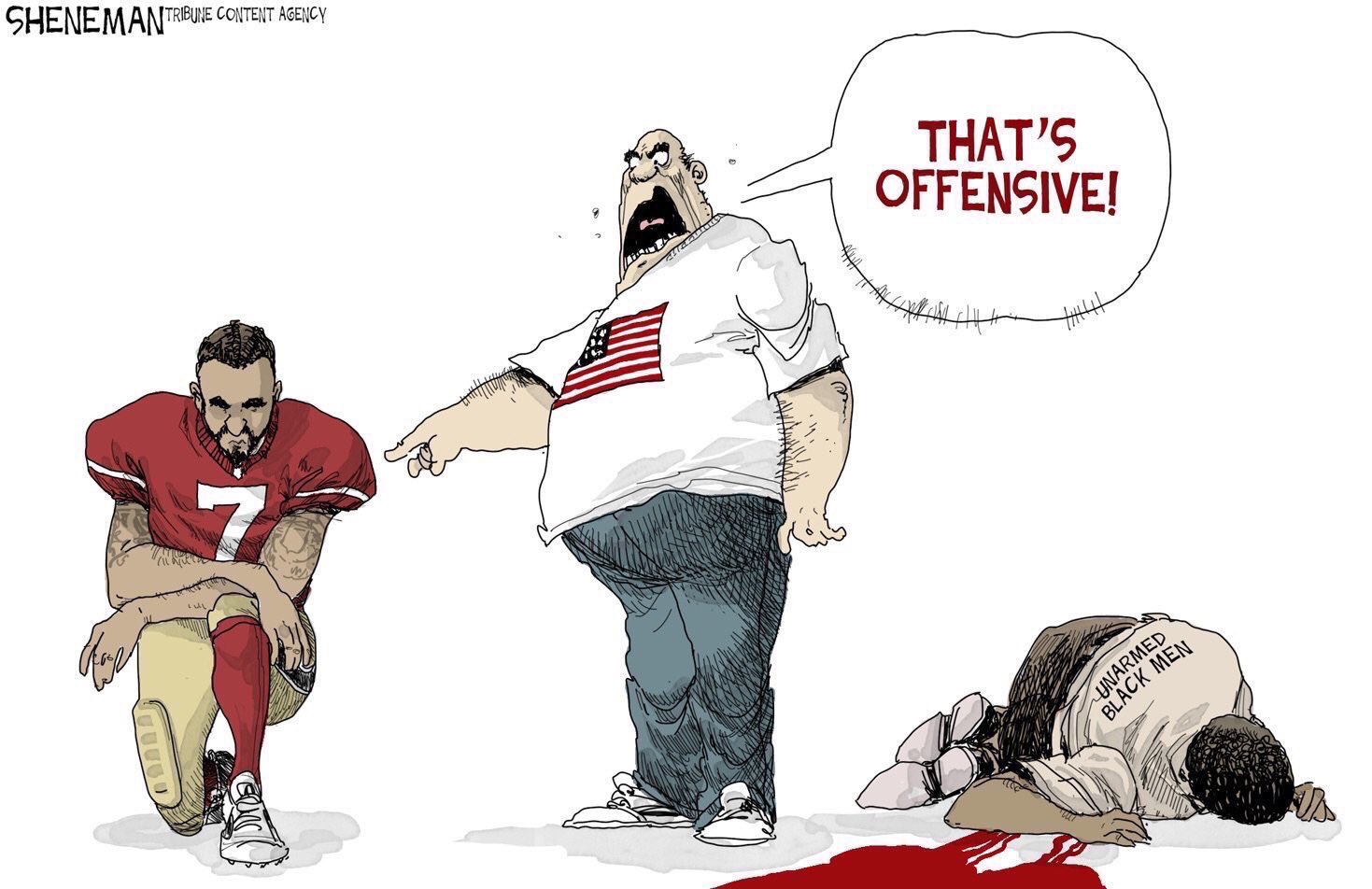
If the NFL benefits immensely from the work of black men, why doesn’t it address serious issues of concern to America’s black community? Specifically, why hasn’t the NFL addressed the issue of unarmed black men being killed by law enforcement? "If you're Comfortable with My Oppression, then You are My Oppressor".

If the NFL votes to force players to stand, civil rights organizations including those that receive "bribe" funding from the NFL need to call for a boycott. I will personally boycott the NFL, just like I did when the WNBA took a stance against its players, and hope others will join me.

As Nick Canon's spoken word poem recently stated, "Stand For What!"

Colin Kaepernick and other players refusing to stand during the national anthem has elicited a greater uproar from the NFL than the existence of police brutality and the killing of unarmed black teens and men. To paraphrase MLK's "Letter from Birmingham Jail", "You deplore the demonstrations taking place by NFL Players. But your statement, I am sorry to say, fails to express a similar concern for the conditions that brought about the demonstrations."

It's bad enough that the league seems to have sanctioned Kaepernick by refusing to hire him, but forcing Black players to stand in direct opposition to their belief or self-interest is unconscionable. If you don't support athletes and entertainers when they stand up for your rights, don't expect them to continue speaking out.

A group of pastors has already called for a Blackout of the NFL, see their video below.

Let's be clear, Colin Kaepernick was standing up for others when he refused to stand; it is very unlikely, he would have personally been a victim of police brutality because of his fame and wealth. He put all that on the line to protect not only his rights but yours and mine as well.

Arpaio pardon could encourage more civil rights violations

File 20170823 6615 9d9a82Then-Republican presidential candidate Donald Trump is joined by Joe Arpaio at a campaign event. AP Photo/Mary Altaffer, File

by Steven Mulroy

President Donald Trump pardoned Joe Arpaio, the former Arizona sheriff who illegally used racial profiling to enforce immigration laws, on Aug. 25.

It’s true, Trump has the legal power to pardon pretty much anyone. But pardoning Arpaio may send the message that state and local officials can aggressively enforce federal immigration law, even if it risks racial profiling and violating the due process rights of citizens and noncitizens.

Legal limits on immigration enforcement

Arpaio has long been known for his harsh practices like requiring inmates to work on chain gangs and live in outdoor tent cities in the scorching Arizona heat. He prioritized immigration enforcement at the expense of crimes like sexual assault.

In 2011, a federal court found that Arpaio’s sheriff’s department unconstitutionally racially profiled Latinos. The court additionally noted that state and county officials had no authority to enforce federal immigration law without authorization from the federal government. Arpaio had no such authorization.

As a former federal prosecutor and Justice Department civil rights lawyer, I know that state and local cooperation can be helpful in enforcing federal law. But as I teach my constitutional law students, when it comes to immigration, federal law usually preempts state law. State overenforcement of immigration law can actually interfere with federal policy. So, state officials should enforce federal immigration law only where the federal government asks them to.

More fundamentally, no federal or state official can legally target people for immigration-related stops and questioning just because they look Latino. And as the Supreme Court has stated, even noncitizens have the right to due process and to be free from racial discrimination, as long as they are present in the U.S.

Arpaio’s detentions and questioning thus broke the law by violating individuals’ due process and Fourth Amendment rights to be free from unreasonable search and seizure. The court ordered Arpaio and his office to stop using race as a factor in its enforcement decisions. His deputies could detain individuals based on probable cause that they had violated some state law, but not merely because they suspected them of being in the U.S. illegally.

Consequences of a pardon

In July, another federal judge convicted Arpaio of criminal contempt for intentionally violating the first court’s prior orders. His sentencing hearing is set for this October.

It is unusual for a president to pardon someone before he or she is sentenced. Doing so suggests that Trump felt Arpaio did nothing wrong.

The pardon may encourage like-minded state and local officials to racially profile Latinos, too. More broadly, it may encourage state and local officers to aggressively enforce federal immigration law. Many experts and law enforcement officials criticize such state and local enforcement, saying it erodes trust with immigrant communities, making them too fearful to report local crimes and cooperate with police.

Arpaio’s pardon does not mean a complete clean slate for him. It would not erase a separate court ruling from 2016 that found him in civil contempt of court. Civil contempt is a noncriminal finding, which could require remedial measures like court-ordered reforms, reporting requirements and the like. These do not fall under the reach of the president’s pardon.

The ConversationNor does a pardon mean that he or his department are allowed to return to their unconstitutional practices. Arpaio himself is now out of office, having lost his most recent election. And the Maricopa County Sheriff Department is still under a court order to refrain from racial profiling and other illegal immigration enforcement efforts. But the pardon may embolden immigration hawks and infuriate Trump’s opponents – which, in the end, might very well be the intention.
Steven Mulroy, Law Professor in Constitutional Law, Criminal Law, Election Law, University of Memphis


Republished with permission under license from The Conversation

‘No Regard for Human Rights’: Sessions Slammed for Order on Police Conduct

by Nadia Prupis

Order is "a clear indication that [Sessions’] Department of Justice is moving toward abandoning its obligations to uphold federal civil rights laws through consent decrees"

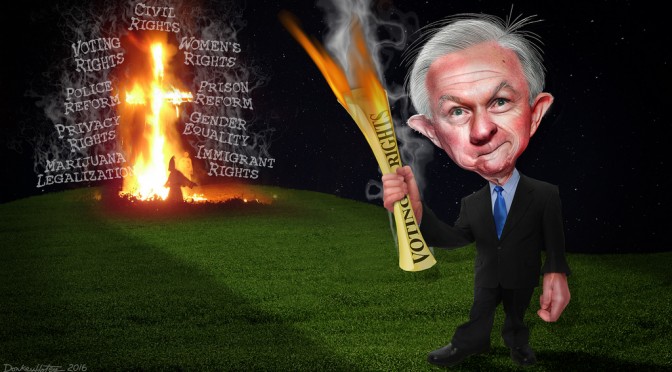
Attorney General Jeff Sessions on Monday ordered a sweeping review of police accountability agreements, prompting a wave of criticism from civil and human rights groups.

Sessions' order means that the Department of Justice (DOJ) may stop using consent decrees that aimed to address police brutality and other institutional problems, or refrain from fully implementing the ones that exist. The attorney general previously opposed the agreements, which are considered a legacy of the Obama administration.

The move is "a clear indication that [Sessions’] Department of Justice is moving toward abandoning its obligations to uphold federal civil rights laws through consent decrees," said Wade Henderson, president of the Leadership Conference on Civil and Human Rights.

"Consent decrees are a crucial tool in the Justice Department's enforcement of civil rights in a variety of areas, including addressing police misconduct. They are only issued after careful study, review, and approval by a federal judge, often after a determination that law enforcement acted in an unconstitutional manner," Henderson said. "These latest developments are particularly ironic given that in the same memo outlining a review of these vital consent decrees, Attorney General Sessions also noted that 'local law enforcement must protect and respect the civil rights of all members of the public.'"

In a memorandum dated March 31 and made public Monday, Sessions directed his staff to review whether police departments are adhering to principles put forth by the Trump administration, including one that states "the individual misdeeds of bad actors should not impugn" police officers from "keeping American communities safe."

Many saw the order as a signal that the rightwing White House would disregard recent gains in improving relations between law enforcement and communities of color, an issue that gained public traction since the 2014 Ferguson, Missouri protests.

The Obama administration ordered a comprehensive review of numerous police departments throughout the U.S., which uncovered an unsurprising epidemic of institutional racism and police brutality against people of color.

"Yesterday, the Department of Justice proved what we have known all along: Attorney General Jeff Sessions has no regard for civil and human rights," Rep. Barbara Lee (D-Calif.) said Tuesday. "The decision to target police reforms that have been negotiated with police departments with a documented history of civil rights violations is reprehensible. Let me be clear, this review marks the first step in the Trump administration's misguided 'law and order' agenda that will blunt the progress we made on police reform under President [Barack] Obama's leadership."

"We simply cannot afford to turn back the clock on reforms that prevent innocent black women and men from being gunned down in the streets," Lee said. "The time to resist is now. As a member of the Appropriations Committee, I will fight to block funding for any effort to thwart the urgent need for police reform."

The New York Times reported:

As part of its shift in emphasis, the Justice Department went to court on Monday to seek a 90-day delay in a consent decree to overhaul Baltimore's embattled police department. That request came just days before a hearing, scheduled for Thursday in the United States District Court in Baltimore, to solicit public comment on the agreement, which was reached in principle by the city and the Justice Department in the waning days of the Obama administration.

Ray Kelly, the president of the Baltimore-based No Boundaries Coalition, a citizen advocacy group, told the Times, "This has all been negotiated by the affected parties. Now we have an outside entity telling us what's best for our citizens and our community when he has no experience, no knowledge."

Baltimore was one of several cities, including FergusonCleveland, Ohio; and Seattle, Washington that were part of the Obama administration's efforts to reform relations, after DOJ investigations found systemic issues. The Baltimore consent decree was reached after protests over the police killing of Freddie Gray revealed systemic racial profiling and other discriminatory tactics.

Likewise, David Rocah, senior staff attorney for the American Civil Liberties Union (ACLU) of Maryland, said, "Why is everyone in Baltimore ready to move forward with police reform except Donald Trump's Department of Justice? The Trump administration's move to put off a long-planned public hearing, where the court was going to hear directly from Baltimore residents about their views of the Baltimore Police Department, and the necessity of a consent decree as part of the reform process, is a slap in the face to the people of Baltimore."

"And it is a clear sign that the Trump administration is seeking to undo, and walk away from, the consent decree that is a critical part of reforming Baltimore's police department," Rocah said.

Henderson continued, "The underlying issues that consent decrees address have not disappeared. The attorney general would do well to remember that he must serve the public, and continue to use every tool at his disposal to support police practices that preserve life and protect all."


Republished with permission under license from CommonDreams

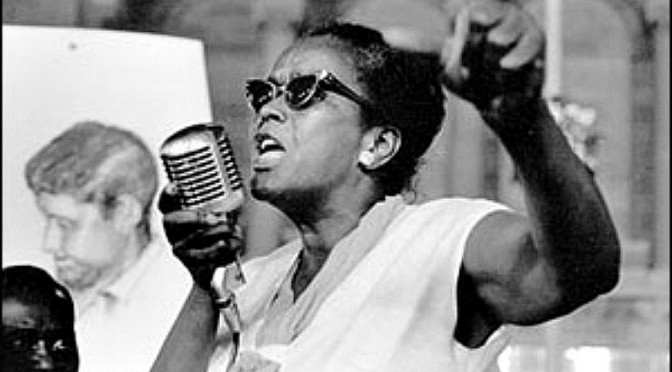
Ella Baker – Mother of the Civil Rights Movement

Ella Josephine Baker (December 13, 1903 – December 13, 1986) was a civil rights and human rights activist. Baker was a largely behind-the-scenes organizer whose career spanned more than five decades. She worked alongside some of the most famous civil rights leaders of the 20th century, including W. E. B. Du Bois, Thurgood Marshall, A. Philip Randolph, and Martin Luther King, Jr. She also mentored many emerging activists, such as Diane Nash, Stokely Carmichael, Rosa Parks, and Bob Moses.

Baker criticized professionalized, charismatic leadership; she promoted grassroots organizing and radical democracy. She has been ranked as "One of the most important African American leaders of the twentieth century and perhaps the most influential woman in the Civil Rights Movement."

Baker was born in Norfolk, Virginia, and raised by her parents Georgiana and Blake Baker. When she was seven, her family moved to her mother's hometown of Littleton in rural North Carolina. As a girl, Baker listened to her grandmother tell stories about slave revolts. Baker's maternal grandmother Josephine Elizabeth "Bet" Ross, had been born into slavery. She was whipped as a young woman for refusing to marry a man chosen for her by the slave master. 

Ella attended local schools. She went to the state capital to attend Shaw University, a historically black university in Raleigh, North Carolina. She graduated as class valedictorian in 1927 at the age of 24. As a student, she challenged school policies which she thought were unfair. After graduating, she moved to New York City during the period of the Great Migration, when many blacks were leaving the South to escape its oppressive society. Baker worked for most of her life-based in New York City.

During 1929-1930 Baker worked as an editorial staff member of the American West Indian News, moving to a position as editorial assistant at the Negro National News. In 1930 George Schuyler, a black journalist and anarchist (and later an arch-conservative), founded the Young Negros' Cooperative League (YNCL). It sought to develop black economic power through collective planning. Having befriended Schuyler, Baker joined his group in 1931 and soon became its national director.

She also worked for the Worker's Education Project of the Works Progress Administration established during President Franklin D. Roosevelt's New Deal. She taught courses in consumer education, labor history, and African history. Baker immersed herself in the cultural and political milieu of Harlem in the 1930s. She protested Italy's invasion of Ethiopia and supported the campaign to free the Scottsboro defendants in Alabama, a group of young black men accused of raping two white women. She also founded the Negro History Club at the Harlem Library and regularly attended lectures and meetings at the YWCA.

During this time, she lived with and married her college sweetheart, T. J. (Bob) Roberts. Their respective work schedules often kept them apart. They finally divorced in 1958. She befriended the future scholar and activist John Henrik Clarke, a future scholar and activist, and Pauli Murray, a future writer and civil rights lawyer, and many others who would become lifelong friends. The Harlem Renaissance influenced Baker in her thoughts and teachings. She advocated widespread, local action as a means of social change. Her emphasis on a grassroots approach to the struggle for equal rights influenced the success of the modern Civil Rights Movement of the mid-20th century.

In 1938 Baker began her long association with the National Association for the Advancement of Colored People (NAACP), which was based in New York City. Baker was hired as a secretary in December 1940. She traveled widely, especially in the South, recruiting members, raising money, and organizing local chapters. She was named the director of branches in 1943, making her the highest-ranking woman in the organization.

Ella Baker, on Sept. 18, 1941

An outspoken woman, she had a strong belief in egalitarian ideals. She pushed the organization to decentralize its leadership structure and to aid its membership in more activist campaigns at the local level. Baker believed that the strength of an organization grew from the bottom up and not the top down. She believed that the work of the branches was the life blood of the NAACP. Baker despised elitism and placed her confidence in many. She believed that the bedrock of any social change organization is not the eloquence or credentials of its top leaders, but in the commitment and hard work of the rank and file membership and willingness and ability of those members to engage in a process of discussion, debate, and decision-making. She especially stressed the importance of young people and women in the organization.

While traveling throughout the South on behalf of the NAACP, Baker met hundreds of black people, establishing lasting relationships with them. She slept in their homes, ate at their tables, spoke in their churches, and earned their trust. She wrote thank-you notes and expressed her gratitude to the people she met. This personalized approach to political work was one important aspect of Baker’s effective effort to recruit more members, men, and women, into the NAACP. Baker formed a network of people in the south who would be important in the continued fight for civil rights. Whereas some northern organizers tended to talk down to rural southerners, Baker’s ability to treat everyone with respect helped her in recruiting. Baker fought to make the NAACP more democratic and in tune with the needs of the people. She tried to find a balance between voicing her concerns and maintaining a unified front.

When the opportunity arose in 1946 to return to New York City to care for her niece, Baker left her position with NAACP. She served as a volunteer. She soon joined the New York branch of the NAACP to work on local school desegregation and police brutality issues. She became its president in 1952. Her job as president was to supervise the field secretaries and coordinate the national office's work with local groups. Baker's top priority as the new director of branches was to lessen the organization's bureaucracy and Walter Francis White's dominating role within it.

She did not believe that the program should be so channeled through White, the executive secretary, and the national office and not the people out in the field. She lobbied for a reduction in the rigid hierarchy within the association and for placing more power in the hands of capable local leaders. She also advocated giving greater responsibility and autonomy to local branches. Between 1944 and 1946, Baker directed revolutionary leadership conferences in several major cities, such as Chicago and Atlanta. She got top officials to deliver lectures, offer welcoming remarks, and conduct workshops. She resigned in 1953 to run unsuccessfully for the New York City Council on the Liberal Party ticket.

In January 1957, Baker went to Atlanta, Georgia to attend a conference aimed at developing a new regional organization to build on the success of the Montgomery Bus Boycott. After a second conference in February, the Southern Christian Leadership Conference (SCLC) was formed. This organization was initially planned to be a loosely structured coalition linking church-based leaders in civil rights struggles across the South. The group wanted to emphasize nonviolence as a means of bringing about social progress and racial justice for southern blacks. The organization would rely on the southern black church for the base of its support. The strength of the organization rested on the political activities of its local church affiliates. It envisioned itself as the political arm of the black church. 

The SCLC first stepped on the political scene as an organization at the Prayer Pilgrimage for Freedom. Baker was instrumental in pulling off this large scale event which became extremely successful. Her work as one of the organizers of this event demonstrated her ability to straddle organizational lines, deliberately ignoring and minimizing rivalries and battles. The conference’s first project was the Crusade for Citizenship, a voter registration campaign. Baker was hired as the first staff person for the new organization. Baker worked closely with southern civil rights activists in Georgia, Alabama, and Mississippi and was highly respected for her organizing abilities. She helped initiate voter registration campaigns and identify other local grievances. After John Tilley, director of the SCLC resigned, she remained in Atlanta for two and a half years as interim executive director of the SCLC until the post was taken up by Wyatt Tee Walker in April 1960.

Baker's job with the SCLC was more frustrating than fruitful. She was unsettled politically, physically, and emotionally. She had no solid allies in the office. Historian Thomas F. Jackson notes that Baker criticized the organization for "programmatic sluggishness and King's distance from the people. King was a better orator than democratic crusader [she] concluded."

In the 1960s, the idea of "participatory democracy" became popular. It was a new formulation, bringing to the traditional appeal of democracy an innovative tie to broader participation.

There were three primary emphases to this new movement:

  • An appeal for grassroots involvement of people throughout society, while making their own decisions
  • The minimization of (bureaucratic) hierarchy and the associated emphasis on expertise and professionalism as a basis for leadership
  • A call for direct action as an answer to fear, isolation, and intellectual detachment

Ella Baker said:

You didn't see me on television, you didn't see news stories about me. The kind of role that I tried to play was to pick up pieces or put together pieces out of which I hoped organization might come. My theory is, strong people don't need strong leaders.

According to activist Mumia Abu-Jamal, Baker advocated a more collectivist model of leadership over the "prevailing messianic style of the period." Baker was largely arguing against the Civil Rights Movement being structured along the organization model of the Black church. The Black church, at the time, had a largely female membership and male leadership. Baker questioned not only the gendered hierarchy of the Civil Rights Movement but also that of the Black church.

Ella Baker and Martin Luther King, Jr., as well as other SCLC members, were reported to have differences in opinion and philosophy during the 1950s and 1960s. She once claimed that the "movement made Martin, and not Martin the movement." When she gave a speech urging activists to take control of the movement themselves, rather than rely on a leader with "heavy feet of clay," it was widely interpreted as a denunciation of King.

That same year, on the heels of regional desegregation sit-ins led by black college students, Baker persuaded the SCLC to invite southern university students to the Southwide Youth Leadership Conference at Shaw University on Easter weekend. This was a gathering of sit-in leaders to meet, assess their struggles and explore the possibilities for future actions. At this meeting, the Student Nonviolent Coordinating Committee (SNCC, pronounced "snick") was formed.

Baker saw the potential for a special type of leadership by the young sit-in leaders, who were not yet prominent in the movement. She believed they could revitalize the Black Freedom Movement and take it in a new direction. Baker wanted to bring the sit-in participants together in a way that would sustain the momentum of their actions, teach them the skills necessary, provide the resources that were needed, and also help them to coalesce into a more militant and democratic force. To this end, she strove to keep the students independent of the older, church-based leadership. In her address at Shaw, she warned the activists to be wary of "leader-centered orientation." Julian Bond later described the speech as "an eye opener" and probably the best of the conference. "She didn't say, 'Don't let Martin Luther King tell you what to do,' " Bond remembers, "but you got the real feeling that that's what she meant."

SNCC became the most active organization in the deeply oppressed Mississippi Delta. It was relatively open to women. Following the conference, Baker resigned from the SCLC and began a long and close relationship with SNCC. Along with Howard Zinn, Baker was one of SNCC's highly revered adult advisors, called the "Godmother of SNCC."{{cn}]

In 1961 Baker persuaded the SNCC to form two wings: one wing for direct action and the second wing for voter registration. It was with Baker’s help that SNCC (along with the Congress of Racial Equality) coordinated the region-wide Freedom Rides of 1961. They also expanded their grassroots movement among black sharecroppers, tenant farmers and others throughout the South. Ella Baker insisted that "strong people don't need strong leaders," and criticized the notion of a single charismatic leader of movements for social change. In keeping the idea of "participatory democracy", Baker wanted each person to get involved. She also argued that "people under the heel," the most oppressed members of any community, "had to be the ones to decide what action they were going to take to get (out) from under their oppression".

She was a teacher and mentor to the young people of SNCC, influencing such important future leaders as Julian Bond, Diane Nash, Stokely Carmichael, Curtis Muhammad, Bob Moses, and Bernice Johnson Reagon. Through SNCC, Baker’s ideas of group-centered leadership and the need for radical democratic social change spread throughout the student movements of the 1960s. For instance, the Students for a Democratic Society, the major antiwar group of the day, promoted participatory democracy. These ideas also influenced a wide range of radical and progressive groups that would form in the 1960s and 1970s.

In 1964 Baker helped organize the Mississippi Freedom Democratic Party (MFDP) as an alternative to the all-white Mississippi Democratic Party. She worked as the coordinator of the Washington office of the MFDP and accompanied a delegation of the MFDP to the 1964 National Democratic Party convention in Atlantic City, New Jersey. The group wanted to challenge the national party to affirm the rights of African Americans to participate in party elections in the South, where they were still largely disenfranchised. When MFDP delegates challenged the pro-segregationist, all-white official delegation, a major conflict ensued. The MFDP delegation was not seated, but their influence on the Democratic Party later helped to elect many black leaders in Mississippi. They forced a rule change to allow women and minorities to sit as delegates at the Democratic National Convention.

Fannie Lou Hamer and Ella Baker, in 1964 at a Mississippi Freedom Democratic Party meeting

The 1964 schism with the national Democratic Party led SNCC toward the "black power" position. Baker was less involved with SNCC during this period, but her withdrawal was due more to her declining health than to ideological differences. According to her biographer Barbara Ransby, Baker believed that black power was a relief from the "stale and unmoving demands and language of the more mainstream civil rights groups at the time." She also accepted the turn towards armed self-defense that SNCC made in the course of its development. Her friend and biographer Joanne Grant wrote that "Baker, who always said that she would never be able to turn the other cheek, turned a blind eye to the prevalence of weapons. While she herself would rely on her fists … she had no qualms about target practice."

From 1962 to 1967, Baker worked on the staff of the Southern Conference Education Fund (SCEF). Its goal was to help black and white people work together for social justice; the interracial desegregation and human rights group was based in the South. SCEF raised funds for black activists, lobbied for implementation of President John F. Kennedy's civil rights proposals, and tried to educate southern whites about the evils of racism. Federal civil rights legislation was passed by Congress and signed by President Lyndon B. Johnson in 1964 and 1965, but implementation would take years.

In SCEF, Baker worked closely with her friend Anne Braden, a white, long-time anti-racist activist. Braden had been accused in the 1950s of being a communist by the House Un-American Activities Committee (HUAC). Baker believed that socialism was a humane alternative to capitalism, but she had mixed feelings about communism. She became a staunch defender of Anne Braden and her husband Carl; she encouraged SNCC to reject red-baiting because she viewed it as divisive and unfair. During the 1960s, Baker participated in a speaking tour and co-hosted several meetings on the importance of linking civil rights and civil liberties. 

In 1967 Ella Baker returned to New York City, where she continued her activism. She later collaborated with Arthur Kinoy and others to form the Mass Party Organizing Committee, a socialist organization. In 1972 she traveled the country in support of the "Free Angela" campaign, demanding the release of activist and writer Angela Davis, who had been arrested in California as a communist. Davis was acquitted after representing herself in court.

Baker also supported the Puerto Rican independence movement and spoke out against apartheid in South Africa. Baker allied with a number of women's groups, including the Third World Women's Alliance and the Women's International League for Peace and Freedom. She remained an activist until her death in 1986 on her 83rd birthday.

Ella Baker was a very private person. Many people close to her did not know that she was married for twenty years to T. J. "Bob" Roberts. Baker kept her own surname. She left no diaries.


Part of the Court.rchp.com 2017 Black History Month Series


Article text republished from Wikipedia.

Benjamin O. Davis Jr. – First Black Air Force General

Benjamin Oliver Davis Jr. (December 18, 1912 – July 4, 2002) was the first African-American general of the United States Air Force and commander of the World War IITuskegee Airmen. He was born in Washington, D.C., the second of three children born to Benjamin O. Davis Sr. and Elnora Dickerson Davis.

At the age of 13, in the summer of 1926, the younger Davis went for a flight with a barnstorming pilot at Bolling Field in Washington, D.C. The experience led to his determination to become a pilot himself. He was the first officer to get his wings from the Tuskegee Army Air Field on March 7, 1942.

After attending the University of Chicago, he entered the United States Military Academy at West Point, New York in 1932.

Benjamin O. Davis while enrolled in West Point

He was sponsored by Representative Oscar De Priest (R-IL) of Chicago, at the time, the only black member of Congress. During the four years of his Academy term, Davis was racially isolated by his White classmates, few of whom spoke to him outside the line of duty. He never had a roommate. He ate by himself. His classmates hoped that this would drive him out of the Academy. The "silent treatment" had the opposite effect. It made Davis more determined to graduate. Nevertheless, he earned the respect of his classmates, as evidenced by the biographical note beneath his picture in the 1936 yearbook, the Howitzer:

The courage, tenacity, and intelligence with which he conquered a problem incomparably more difficult than plebe year won for him the sincere admiration of his classmates, and his single-minded determination to continue in his chosen career cannot fail to inspire respect wherever fortune may lead him.

Lt. Benjamin O. Davis, Jr., receiving his diploma from General John J. Pershing, during his graduation from West Point Military Academy.

He graduated in 1936, 35th in a class of 276. He was the academy's fourth black graduate after Henry Ossian Flipper (1877), John Hanks Alexander (1887), and Charles Young (1889). When he was commissioned as a second lieutenant, the Army had a grand total of two black line officers – Benjamin O. Davis Sr. and Benjamin O. Davis Jr. After graduation, he married Agatha Scott.

At the start of his junior year at West Point, Davis had applied for the Army Air Corps but was rejected because it did not accept blacks. He was instead assigned to the all-black 24th Infantry Regiment (one of the original Buffalo Soldier regiments) at Fort Benning, Georgia. He was not allowed inside the base officers' club.

He later attended the U.S. Army Infantry School at Fort Benning, but then was assigned to teach military tactics at Tuskegee Institute, a historically black college in Tuskegee, Alabama. This was something his father had done years before. It was the Army's way to avoid having a black officer in command of white soldiers.

Chief Civilian Flight Instructor Charles Alfred Anderson took Eleanor Roosevelt on an hour-long flight during her 1941 visit to the Tuskegee Institute. Here they are pictured aboard the aircraft shortly after landing. Airforce Historical Research Agency photo.

Early in 1941, the Roosevelt administration, in response to public pressure for greater black participation in the military as war approached, ordered the War Department to create a black flying unit. Captain Davis was assigned to the first training class at Tuskegee Army Air Field (hence the name Tuskegee Airmen), and in March 1942 earned his wings as one of five black officers to complete the course. He was the first black officer to solo an Army Air Corps aircraft.

In July that year, having been promoted to lieutenant colonel, he was named commander of the first all-black air unit, the 99th Pursuit Squadron.

The squadron, equipped with Curtiss P-40 fighters, was sent to Tunisia in North Africa in the spring of 1943. On June 2, they saw combat for the first time in a dive-bombing mission against the German-held island of Pantelleria as part of Operation Corkscrew. The squadron later supported the Allied invasion of Sicily.

In September 1943, Davis was deployed to the United States to take command of the 332nd Fighter Group, a larger all-black unit preparing to go overseas.

Soon after his arrival, however, there was an attempt to stop the use of black pilots in battle. Senior officers in the Army Air Forces recommended to the Army chief of staff, General George Marshall, that the 99th (Davis's old unit) be removed from combat operations as it had performed poorly. This infuriated Davis as he had never been told of any deficiencies with the unit. He held a news conference at The Pentagon to defend his men and then presented his case to a War Department committee studying the use of black servicemen.

Marshall ordered an inquiry but allowed the 99th to continue fighting in the meantime. The inquiry eventually reported that the 99th's performance was comparable to other air units, but any questions about the squadron's fitness were answered in January 1944 when its pilots shot down 12 German planes in two days while protecting the Anzio beachhead.

Colonel Davis standing near the nose of a P-47 Thunderbolt, 1944

Colonel Davis and his 332d Fighter Group arrived in Italy soon after that. The four-squadron group, which was called the Red Tails for the distinctive markings of its planes, were based at Ramitelli Airfield and flew many missions deep into German territory. By summer 1944 the Group had transitioned to P-47 Thunderbolts.

In the summer of 1945, Davis took over the all-black 477th Bombardment Group, which was stationed at Godman Field, Kentucky.

During the war, the airmen commanded by Davis had compiled an outstanding record in combat against the Luftwaffe. They flew more than 15,000 sorties, shot down 111 enemy planes, and destroyed or damaged 273 on the ground at a cost of 66 of their own planes and losing only about twenty-five bombers.

Davis himself led dozens of missions in P-47 Thunderbolts and P-51 Mustangs. He received the Silver Star for a strafing run into Austria and the Distinguished Flying Cross for a bomber-escort mission to Munich on June 9, 1944.

In July 1948, President Harry S. Truman signed Executive Order 9981 ordering the racial integration of the armed forces. Colonel Davis helped draft the Air Force plan for implementing this order. The Air Force was the first of the services to integrate fully.

Davis served at the Pentagon and in overseas posts over the next two decades. He again saw combat in 1953 when he assumed command of the 51st Fighter-Interceptor Wing (51 FIW) and flew an F-86 Sabre in Korea.

He served as Director of Operations and Training at Far East Air Forces Headquarters, Tokyo, from 1954 until 1955, when he assumed the position of Vice Commander, Thirteenth Air Force (13 AF), with additional duty as commander, Air Task Force 13 (Provisional), Taipei, Taiwan. During his time in Tokyo, he was temporarily promoted to the rank of Brigadier General, a rank not made permanent until after his temporary promotion to Major General.

In April 1957 General Davis arrived at Ramstein Air Base, Germany, as chief of staff, Twelfth Air Force (12 AF), U.S. Air Forces in Europe (USAFE). When the Twelfth Air Force was transferred to James Connally Air Force Base, Texas in December 1957, he assumed new duties as deputy chief of staff for operations, Headquarters U.S. Air Forces in Europe (USAFE), Wiesbaden Air Base, Germany. While in Germany he was temporarily promoted to major general in 1959, and his promotion to brigadier general was made permanent in 1960.

In July 1961, he returned to the United States and Headquarters U.S. Air Force where he served as the director of manpower and organization, deputy chief of staff for programs and requirements, having his promotion to major general made permanent early the next year; and in February 1965 he was assigned as assistant deputy chief of staff, programs, and requirements. He remained in that position until his assignment as chief of staff for the United Nations Command and U.S. Forces in Korea (USFK) in April 1965, at which time he was promoted to lieutenant general. He assumed command of the Thirteenth Air Force (13 AF) at Clark Air Base in the Republic of the Philippines in August 1967.

Davis was assigned as deputy commander in chief, U.S. Strike Command, with headquarters at MacDill Air Force Base, Florida, in August 1968, with additional duty as commander in chief, Middle-East, Southern Asia and Africa. He retired from active military service on February 1, 1970.

At the time of Davis's retirement, he held the rank of lieutenant general, but on December 9, 1998, President Bill Clinton awarded him a fourth star, raising him to the rank of full general. After retirement, he headed the federal sky marshal program, and in 1971 was named Assistant Secretary of Transportation for Environment, Safety, and Consumer Affairs. Overseeing the development of airport security and highway safety, Davis was one of the chief proponents of the 55 miles per hour speed limit to save gasoline and lives. He retired from the Department of Transportation in 1975, and in 1978 served on the American Battle Monuments Commission, on which his father had served decades before.

Both Benjamin O. Davis Jr. and his wife died months apart in 2002. Davis's wife Agatha died in early 2002. Davis, who had been suffering from Alzheimer's disease, died aged 89 on July 4, 2002, at Walter Reed Army Medical Center in Washington, D.C. Davis was buried July 17, at Arlington National Cemetery. A Red Tail P-51 Mustang, similar to the one he had flown in World War II, flew overhead during funeral services.

His military decorations included the Air Force Distinguished Service MedalArmy Distinguished Service MedalSilver StarLegion of Merit with two oak leaf clustersDistinguished Flying CrossAir Medal with four oak leaf clustersArmy Commendation Medal with two oak leaf clusters, and the Philippine Legion of Honor.


Part of the Court.rchp.com 2017 Black History Month Series


Article text republished from Wikipedia.

IDA B. WELLS – Pioneering Journalist

Ida Bell Wells-Barnett, more commonly known as Ida B. Wells (July 16, 1862 – March 25, 1931), was an African-American journalist, newspaper editor, suffragist, sociologist, feminist, Georgist, and an early leader of the Civil Rights Movement. She was one of the founders of the National Association for the Advancement of Colored People (NAACP) in 1909.

Born in Holly Springs, Mississippi, Ida was one of eight children, she lost her parents, James Wells and Elizabeth "Lizzie" (Warrenton) Wells and a sibling in the 1878 yellow fever epidemic at a young age. Both of Ida's parents were enslaved by Spires Bolling, an architect. The family resided at Bolling's house, now named the Bolling-Gatewood House, where Lizzie Wells was a cook. A religious woman, Elizabeth Wells was very strict with her children. Both of Ida's parents were active in the Republican Party during Reconstruction.

Ida's father was a master at carpentry; after the Civil War and emancipation, he was known as a "race man" who worked for the advancement of black people. He was very interested in politics and became a member of the Loyal League. He attended Shaw University in Holly Springs (now Rust College), but he dropped out to help his family. He also attended public speeches and campaigned for local black candidates but never ran for office himself.

Ida attended Shaw like her father, but she was expelled for rebellious behavior after confronting the college president. While visiting her grandmother in the Mississippi Valley in 1878, Ida, then aged 16, received word that Holly Springs had suffered a yellow fever epidemic. Both of her parents and her infant brother (Stanley) died during that event, leaving her and her five other siblings orphaned.

Following the funerals of her parents and brother, friends and relatives decided that the six remaining Wells children should be split up and sent to various foster homes. Wells resisted this solution. To keep her younger siblings together as a family, she found work as a teacher in a black elementary school.

Her paternal grandmother, Peggy Wells, along with other friends and relatives, stayed with her siblings and cared for them during the week while Wells was away teaching. Without this help, she would not have been able to keep her siblings together.

Wells resented that white teachers were paid $80 a month in the segregated school system, and she was paid only $30 a month. This discrimination made her more interested in the politics of race and improving the education of black people.

Ida B. Wells c. 1883

In 1883, Wells took three of her younger siblings to Memphis, Tennessee, to live with her aunt and to be closer to other family members. She also learned that she could earn higher wages there as a teacher than in Mississippi. Soon after moving, she was hired in Woodstock for the Shelby County school system.

During her summer vacations, she attended summer sessions at Fisk University, a historically black college in Nashville. She also attended LeMoyne. She held strong political opinions and provoked many people with her views on women's rights. At 24, she wrote, "I will not begin at this late day by doing what my soul abhors; sugaring men, weak deceitful creatures, with flattery to retain them as escorts or to gratify a revenge."

On May 4, 1884, a train conductor with the Memphis and Charleston Railroad ordered Wells to give up her seat in the first-class ladies car and move to the smoking car, which was already crowded with other passengers. The year before, the Supreme Court had ruled against the federal Civil Rights Act of 1875 (which had banned racial discrimination in public accommodations). This verdict supported railroad companies that chose to racially segregate their passengers.

Wells refused to give up her seat. The conductor and two men dragged Wells out of the car. When she returned to Memphis, she hired an African-American attorney to sue the railroad. Wells gained publicity in Memphis when she wrote a newspaper article for The Living Way, a black church weekly, about her treatment on the train. When her lawyer was paid off by the railroad, she hired a white attorney. She won her case on December 24, 1884, when the local circuit court granted her a $500 award.

The railroad company appealed to the Tennessee Supreme Court, which reversed the lower court's ruling in 1887. It concluded, "We think it is evident that the purpose of the defendant in error was to harass with a view to this suit, and that her persistence was not in good faith to obtain a comfortable seat for the short ride."

 Wells was ordered to pay court costs. Wells' reaction to the higher court's decision expressed her strong convictions on civil rights and religious faith, as she responded: "I felt so disappointed because I had hoped such great things from my suit for my people…O God, is there no…justice in this land for us?"

While teaching elementary school, Wells was offered an editorial position for the Evening Star in Washington, DC. She also wrote weekly articles for The Living Way weekly newspaper under the pen name "Iola," gaining a reputation for writing about the race issue. In 1889, she became co-owner and editor of Free Speech and Headlight, an anti-segregation newspaper that was started by the Reverend Taylor Nightingale and was based at the Beale Street Baptist Church in Memphis. It published articles about racial injustice.

In 1891, Wells was dismissed from her teaching post by the Memphis Board of Education due to her articles that criticized conditions in the colored schools of the region. Wells was devastated but undaunted, and concentrated her energy on writing articles for The Living Way and the Free Speech and Headlight.

In 1889 Thomas Moss, a friend of Wells, opened the Peoples Grocery in the "Curve," a black neighborhood just outside the Memphis city limits. It did well and competed with a white-owned grocery store across the street. While Wells was out of town in Natchez, Mississippi, a white mob invaded her friends' store. During the altercation, three white men were shot and injured. Moss and two other black men, named McDowell and Stewart, were arrested and jailed pending trial. A large white lynch mob stormed the jail and killed the three men.

After the lynching of her friends, Wells wrote in Free Speech and Headlight, urging blacks to leave Memphis altogether:

There is, therefore, only one thing left to do; save our money and leave a town which will neither protect our lives and property, nor give us a fair trial in the courts, but takes us out and murders us in cold blood when accused by white persons.

Wells emphasized the public spectacle of the lynching. More than 6,000 black people did leave Memphis; others organized boycotts of white-owned businesses. After being threatened with violence, she bought a pistol. She later wrote, "They had made me an exile and threatened my life for hinting at the truth."

Ida Wells concluded that perhaps armed resistance was the Nubian's only defense against lynching and recommended that black people use arms to defend against lynching:

The lesson this teaches and which every Afro-American should ponder well, is that a Winchester rifle should have a place of honour in every black home, and it should be used for that protection which the law refuses to give. When the white man who is always the aggressor knows he runs as great a risk of biting the dust every time his Afro-American victim does, he will have greater respect for Afro-American life. The more the Afro-American yields and cringes and begs, the more he has to do so, the more he is insulted, outraged and lynched.

The murder of her friends drove Wells to research and document lynchings and their causes. She began investigative journalism by looking at the charges given for the murders, which officially started her anti-lynching campaign. She spoke on the issue at various black women's clubs and raised more than $500 to investigate lynchings and publish her results.

Wells found that black people were lynched for such social control reasons as failing to pay debts, not appearing to give way to whites, competing with whites economically, and being drunk in public. She found little basis for the frequent claim that black men were lynched because they had sexually abused or attacked white women. This alibi seemed to have partly accounted for white America's collective acceptance or silence on lynching, as well as its acceptance by many in the educated African-American community. Before her friends were lynched and she conducted research, Wells had concluded that "although lynching was…contrary to law and order…it was the terrible crime of rape [that] led to the lynching; [and] that perhaps…the mob was justified in taking his [the rapist’s] life".

Cover of Southern Horrors: Lynch Law in All Its Phases

In 1892 Wells published her findings in a pamphlet entitled "Southern Horrors: Lynch Law in All Its Phases." Having examined many accounts of lynchings due to the alleged "rape of white women," she concluded that Southerners cried rape as an excuse to hide their real reasons for lynchings: black economic progress, which threatened white Southerners with competition, and white ideas of enforcing black second-class status in the society.

She followed this with an editorial that suggested that unlike the myth that white women were sexually at risk of attacks by black men, most liaisons between black men and white women were consensual. After the editorial was published, Wells left Memphis for a short trip to New England, to cover another story for the newspaper. Her editorial enraged white men in Memphis. Their responses in two leading white newspapers, The Daily Commercial and The Evening Scimitar, were brimming with hatred; "the fact that a black scoundrel is allowed to live and utter such loathsome…calumnies is a volume of evidence as to the wonderful patience of southern whites. But we have had enough of it". On May 27, 1892, while she was away in Philadelphia, a white mob destroyed the offices of the Free Speech and Headlight.

Numerous other studies have supported Wells' findings of lynching as a form of community control and analyzed variables that affect lynching. Beck and Tolnay's influential 1990 study found that economics played a major role, with the rate of lynchings higher when marginal whites were under threat because of uncertain economic conditions. They concluded the following:

…[L]ynchings were more frequent in years when the "constant dollar" price of cotton was declining and inflationary pressure was increasing. Relative size of the black population was also positively related to lynching. We conclude that mob violence against southern black people responded to economic conditions affecting the financial fortunes of southern whites—especially marginal white farmers.

According to scholar Oliver C. Cox in his 1945 article "Lynching and the Status Quo," the definition of lynching is "an act of homicidal aggression committed by one people against another through mob action…for the purpose of suppressing…[or] subjugating them further".

In an effort to raise awareness and opposition to lynching, Wells spoke to groups in New York City, where her audiences included many leading African-American women. On October 5, 1892, a testimonial dinner held at Lyric Hall, organized by political activists and clubwomen, Victoria Earle Matthews and Maritcha Remond Lyons, raised significant funds for Wells' anti-lynching campaign. The Women's Loyal Union of New York and Brooklyn was formed to organize black women as an interest group who could act politically.

Because of the threats to her life, Wells left Memphis altogether and moved to Chicago. She continued to wage her anti-lynching campaign and to write columns attacking Southern injustices. Her articles were published in The New York Age newspaper. She continued to investigate lynching incidents and the ostensible causes in the cases.

Together with Frederick Douglass and other black leaders, she organized a black boycott of the 1893 World's Columbian Exposition in Chicago, for its failure to collaborate with the black community on exhibits to represent African-American life. Wells, Douglass, Irvine Garland Penn, and Well's future husband Ferdinand Lee Barnett wrote sections of a pamphlet to be distributed there: "Reasons Why the Colored American Is Not in the World's Columbian Exposition." It detailed the progress of blacks since their arrival in America and also exposed the basis of Southern lynchings. Wells later reported to Albion W. Tourgée that copies of the pamphlet had been distributed to more than 20,000 people at the fair. After the World's Fair in Chicago, Wells decided to stay in the city instead of returning to New York. That year she started work with the Chicago Conservator, the oldest African-American newspaper in the city.

Also in 1893, Wells contemplated a libel suit against two black Memphis attorneys. She turned to Tourgée, who had trained and practiced as a lawyer and judge, for possible free legal help. Deeply in debt, Tourgée could not afford to help but asked his friend Ferdinand Barnett for his aid. Born in Alabama, Barnett had become the editor of the Chicago Conservator in 1878. He served as an assistant state attorney for 14 years. Barnett accepted the pro bono job.

Wells took two tours to Europe in her campaign for justice, the first in 1893 and the second in 1894. In 1893, Wells went to Great Britain at the invitation of Catherine Impey, a British Quaker. An opponent of imperialism and proponent of racial equality, Impey wanted to ensure that the British public learned about the problem of lynching in the US. Wells rallied a moral crusade among the British. Wells accompanied her speeches with a photograph of a white mob and grinning white children posing near a hanged black man; her talks created a sensation, but some in the audiences remained doubtful of her accounts. Wells intended to raise money and expose the US lynching violence but received so little funds that she had difficulty covering her travel expenses. 

In 1894, Wells helped form a Republican Women's Club in Illinois in response to women being granted the right to vote for a state elective office and the right to hold elective office as Trustee of the University of Illinois. The club organized to support the nomination by the Republican Party of Lucy L. Flower to that position, and Flower was eventually elected.

In 1894 before leaving the US for her second visit to Great Britain, Wells called on William Penn Nixon, the editor of Daily Inter-Ocean, a Republican newspaper in Chicago. It was the only major white paper that persistently denounced lynching. After she told Nixon about her planned tour, he asked her to write for the newspaper while in England. She was the first African-American woman to be a paid correspondent for a mainstream white newspaper. (Tourgée had been writing a column for the same paper.)

Wells took her anti-lynching campaign to Europe with the help of many supporters. Trying to organize African-American groups across the United States, in 1896, Wells founded the National Association of Colored Women's Clubs and the National Afro-American Council.

Her article "In Pembroke Chapel" recounted the mental journey that an English minister had shared with her. C. F. Aked had invited Wells to speak. He told her he had found it difficult to accept the level of violence she recounted in her earlier accounts of lynching. He had traveled to the US for the 1893 Chicago World's Fair, and while there, read in local papers about the Miller lynching in Bardwell, Kentucky. He realized that Wells' accounts were accurate.

Wells was highly effective in speaking to European audiences, who were shocked to learn about the rate of violence against black people in the U.S. Her two tours in Europe helped gain support for her cause. She called for the formation of groups to formally protest the lynchings. Wells helped catalyze anti-lynching groups in Europe, which tried to press the U.S. government to guarantee the safety of blacks in the South.

Photo of Ferdinand Lee Barnett, Wells' husband, from 1900.

In 1895, Wells married attorney Ferdinand L. Barnett, a widower with two sons, Ferdinand and Albert. She was one of the first married American women to keep her own last name as well as taking her husband's.

Ida B Wells with her four children, 1909

The couple had four more children: Charles, Herman, Ida, and Alfreda. In the chapter of her Crusade For Justice autobiography, called A Divided Duty, Wells described the difficulty she had splitting her time between her family and her work. She continued to work after the birth of her first child, traveling and bringing the infant Charles with her. Although she tried to balance her world, she could not be as active in her work. Susan B. Anthony said she seemed "distracted". After having her second child, Wells stepped out of her touring and public life for a time.

Ida Wells, her husband, their four children with spouses and grandchildren

Wells often encountered and sometimes collaborated with scholar and activist W. E. B. Du Bois. Both condemned lynching. They also competed for attention. They differed in accounts for why Wells' name was excluded from the original list of founders of the NAACP. In his autobiography, Du Bois implied that Wells chose not to be included. But, in her autobiography, Wells complained that Du Bois deliberately excluded her from the list.

Wells worked on urban reform in Chicago during the last thirty years of her life. She also raised her family. After her retirement, Wells began writing her autobiography, Crusade for Justice (1928). She never finished it; she died of uremia (kidney failure) in Chicago on March 25, 1931, at the age of 68.

She was buried in the Oak Woods Cemetery in Chicago. (The cemetery was later integrated by the city.)


Part of the Court.rchp.com 2017 Black History Month Series


Text above republished from Wikipedia

Orangeburg Massacre of African American College Students by Police

The Orangeburg massacre refers to the shooting and killing of peaceful unarmed black student protesters by white Highway Patrol officers in Orangeburg, SC, on the South Carolina State University campus on the evening of February 8, 1968.

Approximately 200 protesters peacefully demonstrated against racial segregation at a local bowling alley, All Star Bowling lane, without incident on February 6, 1968. The following night many of the students returned to resume the protest but  fifteen of them were arrested.

The third night, February 8th, the students gathered on the South Carolina State University campus instead of at the bowling alley. The students built a bonfire which a law enforcement officer attempted to put out. The officer was injured by a piece of a banister thrown from the crowd. The officers then opened fire into the crowd of students. 

Orangeburg three

Three of those peacefully assembled, Samuel Hammond, Henry Smith, both SC State students and Delano Middleton, a 17-year-old high school student, were killed and twenty-seven other protesters were injured. 

Middleton was not involved in the protests. His mother worked as a maid on campus, and he often stopped there on his way home from basketball practice. In all, he was shot seven times, once in the heart. Henry "Smitty" Smith, an ROTC student and native of Marion, was shot three times, including in his neck. "Sam" or "Sammy" Hammond was a freshman from Barnwell who was studying to be a teacher. He was shot in the back and died on the floor of Orangeburg's segregated hospital. Also killed was the unborn child of Louise Kelly Cawley, age 27, one of the young women beaten during the protest at All Star Bowling. Cawley suffered a miscarriage the following week.

“They committed murder. Murder…that’s a harsh thing to say, but they did it,” …“The police lost their self control. They just started shooting. It was a slaughter. Double ought buckshot is what you use for deer. It’s meant to kill. One guy emptied his service revolver. That takes a lot of shooting. The (students) are running away. Pow, pow, pow, pow, pow, pow!  My God, there’s a murderous intent there. We are lucky more weren’t killed.” –  Ramsey Clark, U.S. Attorney General in 1968.

This tradedy was the first of its king on any American college campus. The massacre pre-dated the 1970 Kent State shootings and Jackson State killings, in which the National Guard at Kent State, and police and state highway patrol at Jackson State, killed student protesters demonstrating against the United States invasion of Cambodia during the Vietnam War.

Background

There were several incidents centering on the segregation of the local bowling alley, All Star Bowling Lane, that led up to the Orangeburg Massacre on February 8, 1968. In the fall of 1967, some of the black leaders within the community tried to convince Harry K. Floyd, the owner of the bowling alley, to allow African Americans.

Harry K. Floyd claimed that the Civil Rights Act of 1964 did not apply to his establishment because it was private. However, because the alley operated a lunch counter, it fell under the jurisdiction of laws regulating interstate commerce and thus federal desegregation. Floyd was unwilling to desegregate; as a result protests began in early February 1968.

On February 5, 1968, a group of around forty students from South Carolina State University entered the bowling alley and left peacefully after they were asked to leave by Floyd. The next night more students led by John Stroman returned and entered the bowling alley. This time there were police waiting for them and several students were arrested, including Stroman. After the arrests, more students began showing up, angry that protesters were being arrested. Next the crowd broke a window of the bowling alley and chaos ensued. Police began beating student protesters (both men and women) with billy clubs. That night, eight students were sent to the hospital. 

Over the next couple of days, the tension in Orangeburg escalated. Student protesters submitted a list of demands that consisted of integration and the elimination of discrimination within the community.

The Governor of South Carolina at the time, Robert E. McNair, responded by calling in the National Guard after commenting that black power advocates were running amok in the community.

Over the next two days, about 200 mostly student protesters gathered on the campus of South Carolina State University, a historically black college in Orangeburg, to demonstrate against the continued segregation at the bowling alley.

SC National Guard Troops arrive in Orangeburg on the night of February 8, 1968

By the late evening of February 8th, army tanks and over 100 heavily armed law enforcement officers had cordoned off the campus; 450 more had been stationed downtown.

Conflict

On the night of February 8, 1968, students started a bonfire on the front of SC State's campus. As police and firefighters attempted to put out the fire, officer David Shealy was injured by a thrown object. Shortly thereafter (around 10:30 p.m.) South Carolina Highway Patrol Officers began firing into the crowd of around 200 protesters. Eight Patrol Officers fired carbines, shotguns, and revolvers at the protesters, which lasted around 10 to 15 seconds.

Twenty-seven people were injured in the shooting; most of whom were shot in the back as they were running away, and three African American men were killed. The three men killed were Samuel Hammond, Henry Smith (both SCSU students), and Delano Middleton, a student at the local Wilkinson High School. Middleton was shot while simply sitting on the steps of the freshman dormitory awaiting the end of his mother's work shift.

The police later said that they believed they were under attack by small arms fire.

A newspaper reported, "About 200 Negros  gathered and began sniping with what sounded like 'at least one automatic, a shotgun and other small caliber weapons' and throwing bricks and bottles at the patrolmen." Similarly, a North Carolina newspaper reported that week that students threw firebombs at buildings and that the sound of apparent sniper fire was heard.

Protesters insisted that they did not fire at police officers, but threw objects and insulted the men. An AP photographer on the scene, subsequently revealed that he heard no gunfire from the campus.

Aftermath

At a press conference the following day, Governor Robert E. McNair said the event was "…one of the saddest days in the history of South Carolina". McNair blamed the deaths on outside Black Power agitators and said the incident took place off campus, contrary to the evidence.

Demonstrators protest the shootings.

The federal government brought charges against the state patrolmen in the first federal trial of police officers for using excessive force at a campus protest. The state patrol officers' defense was that they felt they were in danger and protesters had shot at the officers first. All nine defendants were acquitted although thirty-six witnesses stated that they did not hear gunfire coming from the protesters on the campus before the shooting and no students were found to be carrying guns.

In a state trial in 1970, the activist Cleveland Sellers, who had been shot during the attack, was convicted of a charge of riot related to the events on February 6 at the bowling alley. He served seven months in state prison, getting time off for good behavior. He was the national program director of the Student Nonviolent Coordinating Committee (SNCC). In 1973 he wrote The River of No Return: The Autobiography of a Black Militant and the Life and Death of SNCC.

Sellers earned his master's degree from Harvard and his doctorate from the University of North Carolina at Greensboro. For eight years, he served as the president of Voorhees College, located in his hometown of Denmark, before stepping down in 2016 due to failing health.

Cleveland Sellers stands beside the historic marker on the S.C. State University campus at the 2000 Orangeburg memorial.

In 1993, twenty-five years after the massacre, Sellers was officially pardoned by the governor of South Carolina after evidence proved he was innocent.


Part of the Court.rchp.com 2017 Black History Month Series

33 Movies for Black History

We've included 21 full-length movies you can watch now on your computer or device and 12 additional movie trailer recommendations to watch during black history month and beyond. Unfortunately, we cannot possibly list every good move related to black history and there are plenty of excellent movies not included on this list. However, we hope you discover something new and enjoy watching.

Full Movies Which Were Available on the Date of Publication

The Vernon Johns Story (1994 Full Movie)

Vernon Johns (April 22, 1892 – June 11, 1965) was an American minister at several black churches in the South. He is best known as the pastor 1947-52 of the Dexter Avenue Baptist Church in Montgomery Alabama. He was succeeded by Dr. Martin Luther King, Jr. 

The video has been deleted, trailer now shown below.

King (1978 Full Movie)

King was a television miniseries based on the life of Martin Luther King Jr. It aired for three consecutive nights on NBC from February 12 through 14, 1978. 

The Rosa Parks Story 2002

Something the Lord Made (2004 Full Movie)

Based on the true story of Vivien Thomas, a carpenter that wanted to be a doctor, unable to attend college he works for a real doctor as a janitor. Realizing what this young man is capable of the doctor gives him real tasks and as a team, they go to conquer what other people thought impossible. Based on a true story. Vivien Thomas became a black cardiac pioneer and his complex and volatile partnership with white surgeon Alfred Blalock, the world famous "Blue Baby doctor" who pioneered modern heart surgery.

Keep the Faith, Baby – Adam Clayton Powell Movie 2002

Adam Clayton Powell Jr. (November 29, 1908 – April 4, 1972) was a Baptist pastor and an American politician, who represented Harlem, New York City, in the United States House of Representatives (1945–71). He was the first person of African-American descent to be elected from New York to Congress. Oscar Stanton De Priest of Illinois was the first black person to be elected to Congress in the 20th century; Powell was the fourth. Re-elected for nearly three decades, Powell became a powerful national politician of the Democratic Party and served as a national spokesman on civil rights and social issues. 

Deacons for Defense 2003

The Deacons for Defense and Justice was an armed self-defense group of African-Americans that protected civil rights organizations in the U.S. Southern states during the 1960s.

The Tuskegee Airmen 1995

The Tuskegee Airmen was a group of the first African-American military aviators (fighter and bomber) in the United States Armed Forces who fought in World War II. Officially, they formed the 332nd Fighter Group and the 477th Bombardment Group of the United States Army Air Forces. All black World War II military pilots who trained in the United States trained at Moton Field, the Tuskegee Army Air Field, and were educated at Tuskegee University, located near Tuskegee, Alabama.

Ghost of Mississippi 1996

A Mississippi district attorney and the widow of Medgar Evers struggle to finally bring a white racist to justice for the 1963 murder of the civil rights leader. Medgar Wiley Evers (July 2, 1925 – June 12, 1963) was a black civil rights activist from Mississippi who worked to overturn segregation at the University of Mississippi and to enact social justice and voting rights. He was killed by a white segregationist.

Panther 1995

In October of 1966, the Black Panther Party for Self Defense was created in response to challenge police brutality in Oakland.

The Marva Collins Story 1981

Marva Delores Collins (August 31, 1936 – June 24, 2015) was an American educator who started the highly successful Westside Preparatory School in the impoverished Garfield Park neighborhood of Chicago in 1975.

Introducing Dorothy Dandridge 1999

Dorothy Jean Dandridge (November 9, 1922 – September 8, 1965) was an American film and theater actress, singer and dancer. She is perhaps best known for being the first African-American actress to be nominated for an Academy Award for Best Actress for her performance in the 1954 film Carmen Jones

The Josephine Baker Story 1991

Josephine Baker, born in St. Louis, MO, was a singer and entertainer who skyrocketed to international fame as a performer in Paris. Baker renounced her U.S. citizenship because of racism and became a French national and war hero during WWII.

The Jacksons: An American Dream (1992)

Based upon the history of the Jackson family, one of the most successful musical families in show business, and the early and successful years of the popular Motown group The Jackson 5.

The Temptations 1998

Biography of the singers who formed the hit Motown musical act, The Temptations.

Miss Evers Boys

The true story of the U.S. Government's 1932 Tuskegee Syphilis Experiment, in which members of a group of black test subjects were allowed to die, despite a cure having been developed.

The Jackie Robinson Story 1950

Biography of Jackie Robinson, the first black major league baseball player in the 20th century. Traces his career in the Negro Leagues and the major leagues.

The Spook Who Sat By the Door 1973

A black man plays Uncle Tom in order to gain access to CIA training, then uses that knowledge to provide tactical training to street gang members to plot a Black American Revolution.

Sounder 1972

About a loving and strong family of black sharecroppers in Louisiana in 1933, in the midst of the Great Depression, facing a serious family crisis when the husband and father, is convicted of a petty crime and sent to a prison camp.

A Woman Called Moses 1978

Based on the life of Harriet Tubman, the escaped African American slave who helped to organize the Underground Railroad, and who led dozens of African Americans from enslavement in the Southern United States to freedom in the Northern states and Canada.

Ray 2004

The story of the life and career of the legendary rhythm and blues musician Ray Charles.

Hoodlum 1997

A fictionalized account of the gang war between the Italian/Jewish mafia alliance and the Black gangsters of Harlem that took place in the late 1920s and early 1930s based on real events and characters. The film concentrated on Ellsworth "Bumpy" Johnson (Laurence Fishburne), Dutch Schultz (Tim Roth), and Lucky Luciano. 

The video has been deleted, trailer now shown below.

12 Black Movie Trailers to Stream or Rent

Rosewood 1997

Based on historic events of the 1923 Rosewood massacre in Florida, when a racist white lynch mob killed blacks and destroyed their black community.

Amistad 1997

Based on the true story of the 1839 mutiny aboard the slave ship La Amistad, during which Mende tribesmen abducted for the slave trade managed to gain control of their captors' ship off the coast of Cuba, and the international legal battle that followed their capture by a U.S. revenue cutter. The case was ultimately resolved by the United States Supreme Court in 1841.

Roots 1977

Roots was an American television miniseries based on Alex Haley's 1976 novel, Roots: The Saga of an American Family; the series first aired on ABC-TV in January 1977. (Goodbye Uncle Tom is another 70s Slave Movie which was virtually banned from the U.S.)

<iframe width="560" height="315" src="https://www.youtube.com/embed/q5DODfH-mwM" frameborder="0" allow="autoplay; encrypted-media" allowfullscreen></iframe>

Hidden Figures 2016

Hidden Figures is a 2016 American biographical drama film about female African-American mathematicians at NASA.

Malcolm X 1992

Malcolm X is a biographical drama about key events in Malcolm X's life: defining childhood incidents, his criminal career, his incarceration, his conversion to Islam, his ministry as a member of the Nation of Islam and his later falling out with the organization, his marriage, his pilgrimage to Mecca, and his assassination on February 21, 1965. 

American Violet 2008

A single mother struggles to clear her name after being wrongly accused and arrested for dealing drugs in an impoverished town in Texas.

Belle 2013

Based on the true story of Dido Elizabeth Belle, the mixed-race daughter of a Royal Navy Admiral is raised by her aristocratic great-uncle in 18th century England.

A Soldier's Story 1984

Not a true story, but an excellent look at the what was at stake for black people through the lens of the perceived humanity of our black soldiers.

Glory 1989

The film is about one of the first military units of the Union Army during the American Civil War to be made up entirely of African-American men (except for its officers), as told from the point of view of Colonel Shaw, its white commanding officer. 

The Cotton Club 1984

The Cotton Club was a famous night club in Harlem. The story follows the people that visited the club, those that ran it, and is peppered with the Jazz music that made it so famous. The Cotton Club was whites only but featured all black entertainment during the 1920s Harlem Renaissance.

Mississippi Burning 1988

Two FBI agents with wildly different styles arrive in Mississippi to investigate the disappearance of some civil rights activists.

The Retrieval 2013

A fatherless 13-year-old black boy, who survives by working with a white bounty hunter gang who sends him to earn the trust of runaway slaves and wanted black men.


Part of the Court.rchp.com 2017 Black History Month Series

Charles Hamilton Houston – The Man Who Killed Jim Crow

One of the most influential figures in African American life between the two world wars was Charles Hamilton Houston. A scholar and lawyer, he dedicated his life to freeing his people from the bonds of racism.  Houston played a significant role in dismantling the Jim Crow laws, which earned him the title "The Man Who Killed Jim Crow".

Charles Houston grew up in a middle-class family in Washington, D.C. His father, William Le Pre Houston, was an attorney, and his mother, Mary Hamilton Houston, a seamstress. 

Charles Houston with his Father and Mother

Houston enrolled at Amherst College in Massachusetts, where he was elected to Phi Beta Kappa and was one of six valedictorians in 1915. Determined to be a lawyer like his father, Houston taught English for a couple of years back in Washington in order to save enough money to attend Harvard Law School. Houston noticed while teaching, that blacks had not advanced meaningfully in the past 20 years and were becoming increasingly victimized by segregation in the public and private sectors.

As the U.S. entered World War I, Houston joined the then racially segregated U.S. Army as an officer and was sent to France. Houston was an artillery officer in France. He witnessed and endured the racial prejudice inflicted on black soldiers. These encounters fueled his determination to use the law as an instrument of social change. 

Lieutenant Houston in Artillery Unit, World War

Houston returned to the U.S. in 1919 and attended Harvard Law School. He was a member of the Harvard Law Review and graduated cum laude. Houston was also a member of Alpha Phi Alpha fraternity. He received his JD from Harvard in 1923 and that same year was awarded a Sheldon Traveling Fellowship to study at the University of Madrid. When he returned to Washington to join his father’s law firm, he began taking on civil rights cases. He was admitted to the Washington, DC bar in 1924.

William Houston practiced law in Washington, D.C., for more than four decades, and taught legal office management at Howard University’s law school.

Howard University School of Law: Preparing for Struggle

Mordecai Johnson, the first African-American president of Howard University, named Charles Houston to head the law school in 1929. Houston brought an ambitious vision to the school, he set out to train attorneys who would become civil rights advocates. At the time, courses were offered only part-time and in the evening. Houston created an accredited, full-time program with an intensified civil rights curriculum. In Houston's capacity as Dean, he had a direct influence on nearly one-quarter of all the black lawyers in the United States, including former student Thurgood Marshall. Houston transformed a second-rate law school into a first class institution that churned out generations of brilliant black lawyers. His determination to train world-class lawyers who would lead the fight against racial injustice gave African Americans an invaluable weapon in the civil rights struggle.

Howard Law School Course Syllabus

Houston diversified the course offerings and made sure students received more rigorous training for work in the field of civil rights. 

This 1931 memorandum from Houston asked all law school staff to provide an overview of their courses and stated his intention to strengthen the curriculum.

Original HU Law School Building

This row house in downtown Washington was the home of the Howard University law school when Charles Houston was dean. He strengthened the school’s academic standards and instilled a sense of social mission. Under Houston, the law school graduated a group of highly effective civil rights lawyers, the most illustrious of whom was Thurgood Marshall.
Professors at the law school plan a year of coursework.

Houston knew many of the foremost legal minds of his day and brought them to Howard as program advisors and speakers.

In this photograph he poses with Mordecai Johnson, president of the university, and Clarence Darrow, the famed lawyer who defended the theory of evolution in the Scopes trial in 1925.

Charles Houston arguing a case in court

Houston continued to argue cases in court and work for equality in the legal community during his years as dean of Howard’s law school. When the American Bar Association refused to admit African American attorneys, he helped found the National Bar Association, an all-black organization, in 1925.

A New Legal Team at the NAACP

In 1934 Charles Houston left the Howard University School of Law to head the Legal Defense Committee of the NAACP in New York City. Seeking out bright, dedicated attorneys to join the mission, he built an interracial staff that defended victims of racial injustice. Among the lawyers recruited was Thurgood Marshall, Houston’s star student from Howard’s law school.

In July 1938 policy disagreements and health problems caused Houston to relinquish the leadership of the NAACP legal committee to Thurgood Marshall. Summing up Houston’s contribution to the struggle against segregation and racism, Marshall later remarked, “We owe it all to Charlie.”

Through his work at the NAACP, Houston played a role in nearly every civil rights case before the Supreme Court between 1930 and Brown v. Board of Education (1954). Houston's plan to attack and defeat Jim Crow segregation by demonstrating the inequality in the "separate but equal" doctrine from the Supreme Court's Plessy v. Ferguson decision as it pertained to public education in the United States was the masterstroke that brought about the landmark Brown decision. In Missouri ex rel. Gaines v. Canada (1939), Houston argued that it was unconstitutional for Missouri to exclude blacks from the state’s university law school when, under the “separate but equal” provision, no comparable facility for blacks existed within the state.

Houston’s efforts to dismantle the legal theory of “separate but equal” came to fruition after his death in 1950 with the historic Brown v. Board of Education (1954) decision, which prohibited segregation in public schools.


In the documentary "The Road to Brown", Hon. Juanita Kidd Stout described Houston's strategy, 

"When he attacked the "separate but equal" theory his real thought behind it was that "All right, if you want it separate but equal, I will make it so expensive for it to be separate that you will have to abandon your separateness." And so that was the reason he started demanding equalization of salaries for teachers, equal facilities in the schools and all of that." 

Houston took a movie camera across South Carolina to document the inequalities between African-American and white education.

Then, as Special Counsel to the NAACP Houston dispatched Thurgood Marshall, Oliver Hill, and other young attorneys to work to equalize teachers' salaries. Houston led a team of African-American attorneys who used similar tactics to bring to an end the exclusion of African-Americans from juries across the South.

Charles Houston was one of the most important civil rights attorneys in American history. A lawyer, in his view, was an agent for social change—“either a social engineer or a parasite on society.” 


Part of the Court.rchp.com 2017 Black History Month Series


Much of the content above has been republished under license from the Smithsonian and Wikipedia