Category Archives: Civil Rights

“What To The Slave Is The Fourth Of July?” And African American Secularism

"To hold a people in oppression you have to convince them first that they are supposed to be oppressed." … "Powerful people cannot afford to educate the people that they oppress, because once you are truly educated, you will not ask for power. You will take it." – John Henrik Clarke

Also see the page, Slavery isn't over, they just changed what they called it


By Chris Cameron,

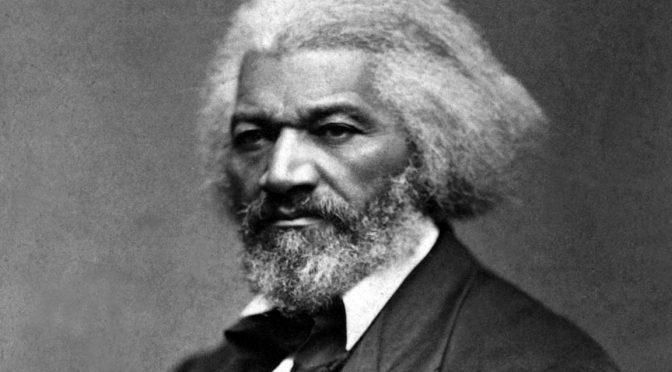
On July 5, 1852, Frederick Douglass gave one of the most powerful antislavery speeches of the 19th century, an effort that historian David Blight refers to as “the rhetorical masterpiece of American abolitionism.”[1] Douglass’s speech in Rochester’s Corinthian Hall is rightfully viewed as an important enunciation of black abolitionist thought and black political theory. Indeed, when I have taught the early U.S. history survey or advanced courses on American intellectual history to the Civil War, that is how I have presented the work. I’d like to suggest another reading for the speech, however, namely as one of the first articulations of African American secularism.

Douglass begins his speech by praising the Founding Fathers and the ideas articulated in the Declaration of Independence. He quickly moves to a critique of America’s civil religion, however, noting that “this Fourth [of] July is yours, not mine. You may rejoice, I must mourn. To drag a man in fetters into the illuminated temple of liberty, and call upon him to join you in joyous anthems, were inhuman mockery and sacrilegious irony.”[2] After blasting America’s civil religion, Douglass goes on to offer one of the strongest critiques of American Christianity among 19th century black abolitionists.

James Earl Jones reads an excerpt from Douglass' speech below. The full text of Fredrick Douglass' speech, "The Meaning of July Fourth for the Negro" is near the bottom of the page.

Douglass notes first that because American churches support the Fugitive Slave Act, “that church regards religion simply as a form of worship, an empty ceremony, and not a vital principle, requiring active benevolence, justice, love and good will towards men.” If ministers throughout the North were to treat the Fugitive Slave Act as a violation of Christian liberty, he argues, there is no way the law would stand. At the same time that the church is indifferent to the sufferings of the slave, he posits, it also “takes sides with the oppressors. It had made itself the bulwark of American slavery, and the shield of American slavehunters. Many of its most eloquent Divines, who stand as the very lights of the church, have shamelessly given the sanction of religion and the Bible to the whole slave system.” For his part, Douglass thundered that he would “welcome infidelity! Welcome atheism! Welcome anything! In preference to the gospel, as preached by those Divines.”[3]

Douglass’s strident anticlericalism articulated in this speech would be a key feature of African American secularism from the mid-19th century to the present. African American secularism can be defined as a commitment to promoting liberty, equality, and economic justice through a focus on reason and human rights rather than the authority of God. This commitment has most often been present among atheists and agnostics, however one’s specific theological orientation is not as important as one’s commitment to fostering the public good by relying on reason and not faith. While Douglass’s religious views, in his words, “pass[ed] over the whole scale and circle of belief and unbelief, from faith in the overruling Providence of God, to the blackest atheism,” for most of his career after the speech on the Fourth of July, he articulated humanistic and secularistic viewpoints when it came to freedom for slaves and equality for blacks.[4] As he notes in his speech before the final meeting of the American Anti-Slavery Society in 1870, while many people have thanked God for freeing the slaves, “I like to thank men…I want to express my love to God and gratitude to God, by thanking those faithful men and women, who have devoted the great energies of their soul to the welfare of mankind. It is only through such men and such women that I can get a glimpse of God anywhere.”[5]

[1] David W. Blight, ed. Narrative of the Life of Frederick Douglass, An American Slave, Written by Himself, with Related Documents 2nd edition (Boston and New York: Bedford/St. Martin’s, 2003), 146.

[2] Frederick Douglass, “What to the Slave is the Fourth of July?,” ibid, 156.

[3] Ibid, 163, 164.

[4] Frederick Douglass, My Bondage and My Freedom, in The Frederick Douglass Papers, Series Two: Autobiographical Writings, Volume 2, ed. John W. Blassingame, et al. (New Haven: Yale University Press, 2003), 130.

[5] Quoted in Herbert Aptheker, “An Unpublished Frederick Douglass Letter” in Anthony B. Pinn, ed. By These Hands: A Documentary History of African American Humanism(New York and London: New York University Press, 2001), 79.


Article text by Chris Cameron re-published under license from the African American Intellectual History Society.


The Vernon Johns Story

Vernon Johns (April 22, 1892 – June 11, 1965) was an American minister at several black churches in the South. He is best known as the pastor 1947-52 of the Dexter Avenue Baptist Church in Montgomery Alabama. He was succeeded by Dr. Martin Luther King, Jr. 

Vernon Johns was the civil rights era version of Frederick Douglas because he challenged the status quo and accepted norms of his day. An excerpt from his story is below and Johns is also portrayed by James Earl Jones as was Douglass above.

Vernon Johns biography at The Vernon Johns Society


"The Meaning of July Fourth for the Negro" – Full Text

Fellow Citizens, I am not wanting in respect for the fathers of this republic. The signers of the Declaration of Independence were brave men. They were great men, too-great enough to give frame to a great age. It does not often happen to a nation to raise, at one time, such a number of truly great men. The point from which I am compelled to view them is not, certainly, the most favorable; and yet I cannot contemplate their great deeds with less than admiration. They were statesmen, patriots and heroes, and for the good they did, and the principles they contended for, I will unite with you to honor their memory…. 

…Fellow-citizens, pardon me, allow me to ask, why am I called upon to speak here to-day? What have I, or those I represent, to do with your national independence? Are the great principles of political freedom and of natural justice, embodied in that Declaration of Independence, extended to us? and am I, therefore, called upon to bring our humble offering to the national altar, and to confess the benefits and express devout gratitude for the blessings resulting from your independence to us? 

Would to God, both for your sakes and ours, that an affirmative answer could be truthfully returned to these questions! Then would my task be light, and my burden easy and delightful. For who is there so cold, that a nation's sympathy could not warm him? Who so obdurate and dead to the claims of gratitude, that would not thankfully acknowledge such priceless benefits? Who so stolid and selfish, that would not give his voice to swell the hallelujahs of a nation's jubilee, when the chains of servitude had been torn from his limbs? I am not that man. In a case like that, the dumb might eloquently speak, and the "lame man leap as an hart." 

But such is not the state of the case. I say it with a sad sense of the disparity between us. I am not included within the pale of glorious anniversary! Your high independence only reveals the immeasurable distance between us. The blessings in which you, this day, rejoice, are not enjoyed in common.ÑThe rich inheritance of justice, liberty, prosperity and independence, bequeathed by your fathers, is shared by you, not by me. The sunlight that brought light and healing to you, has brought stripes and death to me. This Fourth July is yours, not mine. You may rejoice, I must mourn. To drag a man in fetters into the grand illuminated temple of liberty, and call upon him to join you in joyous anthems, were inhuman mockery and sacrilegious irony. Do you mean, citizens, to mock me, by asking me to speak to-day? If so, there is a parallel to your conduct. And let me warn you that it is dangerous to copy the example of a nation whose crimes, towering up to heaven, were thrown down by the breath of the Almighty, burying that nation in irrevocable ruin! I can to-day take up the plaintive lament of a peeled and woe-smitten people! 

"By the rivers of Babylon, there we sat down. Yea! we wept when we remembered Zion. We hanged our harps upon the willows in the midst thereof. For there, they that carried us away captive, required of us a song; and they who wasted us required of us mirth, saying, Sing us one of the songs of Zion. How can we sing the Lord's song in a strange land? If I forget thee, 0 Jerusalem, let my right hand forget her cunning. If I do not remember thee, let my tongue cleave to the roof of my mouth." 

Fellow-citizens, above your national, tumultuous joy, I hear the mournful wail of millions! whose chains, heavy and grievous yesterday, are, to-day, rendered more intolerable by the jubilee shouts that reach them. If I do forget, if I do not faithfully remember those bleeding children of sorrow this day, "may my right hand forget her cunning, and may my tongue cleave to the roof of my mouth!" To forget them, to pass lightly over their wrongs, and to chime in with the popular theme, would be treason most scandalous and shocking, and would make me a reproach before God and the world. My subject, then, fellow-citizens, is American slavery. I shall see this day and its popular characteristics from the slave's point of view. Standing there identified with the American bondman, making his wrongs mine, I do not hesitate to declare, with all my soul, that the character and conduct of this nation never looked blacker to me than on this 4th of July! Whether we turn to the declarations of the past, or to the professions of the present, the conduct of the nation seems equally hideous and revolting. America.is false to the past, false to the present, and solemnly binds herself to be false to the future. Standing with God and the crushed and bleeding slave on this occasion, I will, in the name of humanity which is outraged, in the name of liberty which is fettered, in the name of the constitution and the Bible which are disregarded and trampled upon, dare to call in question and to denounce, with all the emphasis I can command, everything that serves to perpetuate slavery Ñ the great sin and shame of America! "I will not equivocate; I will not excuse"; I will use the severest language I can command; and yet not one word shall escape me that any man, whose judgment is not blinded by prejudice, or who is not at heart a slaveholder, shall not confess to be right and just. 

But I fancy I hear some one of my audience say, "It is just in this circumstance that you and your brother abolitionists fail to make a favorable impression on the public mind. Would you argue more, an denounce less; would you persuade more, and rebuke less; your cause would be much more likely to succeed." But, I submit, where all is plain there is nothing to be argued. What point in the anti-slavery creed would you have me argue? On what branch of the subject do the people of this country need light? Must I undertake to prove that the slave is a man? That point is conceded already. Nobody doubts it. The slaveholders themselves acknowledge it in the enactment of laws for their government. They acknowledge it when they punish disobedience on the part of the slave. There are seventy-two crimes in the State of Virginia which, if committed by a black man (no matter how ignorant he be), subject him to the punishment of death; while only two of the same crimes will subject a white man to the like punishment. What is this but the acknowledgment that the slave is a moral, intellectual, and responsible being? The manhood of the slave is conceded. It is admitted in the fact that Southern statute books are covered with enactments forbidding, under severe fines and penalties, the teaching of the slave to read or to write. When you can point to any such laws in reference to the beasts of the field, then I may consent to argue the manhood of the slave. When the dogs in your streets, when the fowls of the air, when the cattle on your hills, when the fish of the sea, and the reptiles that crawl, shall be unable to distinguish the slave from a brute, then will I argue with you that the slave is a man! 

For the present, it is enough to affirm the equal manhood of the Negro race. Is it not astonishing that, while we are ploughing, planting, and reaping, using all kinds of mechanical tools, erecting houses, constructing bridges, building ships, working in metals of brass, iron, copper, silver and gold; that, while we are reading, writing and ciphering, acting as clerks, merchants and secretaries, having among us lawyers, doctors, ministers, poets, authors, editors, orators and teachers; that, while we are engaged in all manner of enterprises common to other men, digging gold in California, capturing the whale in the Pacific, feeding sheep and cattle on the hill-side, living, moving, acting, thinking, planning, living in families as husbands, wives and children, and, above all, confessing and worshipping the Christian's God, and looking hopefully for life and immortality beyond the grave, we are called upon to prove that we are men! 

Would you have me argue that man is entitled to liberty? that he is the rightful owner of his own body? You have already declared it. Must I argue the wrongfulness of slavery? Is that a question for Republicans? Is it to be settled by the rules of logic and argumentation, as a matter beset with great difficulty, involving a doubtful application of the principle of justice, hard to be understood? How should I look to-day, in the presence of Amercans, dividing, and subdividing a discourse, to show that men have a natural right to freedom? speaking of it relatively and positively, negatively and affirmatively. To do so, would be to make myself ridiculous, and to offer an insult to your understanding. There is not a man beneath the canopy of heaven that does not know that slavery is wrong for him. 

What, am I to argue that it is wrong to make men brutes, to rob them of their liberty, to work them without wages, to keep them ignorant of their relations to their fellow men, to beat them with sticks, to flay their flesh with the lash, to load their limbs with irons, to hunt them with dogs, to sell them at auction, to sunder their families, to knock out their teeth, to burn their flesh, to starve them into obedience and submission to their mastcrs? Must I argue that a system thus marked with blood, and stained with pollution, is wrong? No! I will not. I have better employment for my time and strength than such arguments would imply. 

What, then, remains to be argued? Is it that slavery is not divine; that God did not establish it; that our doctors of divinity are mistaken? There is blasphemy in the thought. That which is inhuman, cannot be divine! Who can reason on such a proposition? They that can, may; I cannot. The time for such argument is passed. 

At a time like this, scorching irony, not convincing argument, is needed. O! had I the ability, and could reach the nation's ear, I would, to-day, pour out a fiery stream of biting ridicule, blasting reproach, withering sarcasm, and stern rebuke. For it is not light that is needed, but fire; it is not the gentle shower, but thunder. We need the storm, the whirlwind, and the earthquake. The feeling of the nation must be quickened; the conscience of the nation must be roused; the propriety of the nation must be startled; the hypocrisy of the nation must be exposed; and its crimes against God and man must be proclaimed and denounced. 

What, to the American slave, is your 4th of July? I answer; a day that reveals to him, more than all other days in the year, the gross injustice and cruelty to which he is the constant victim. To him, your celebration is a sham; your boasted liberty, an unholy license; your national greatness, swelling vanity; your sounds of rejoicing are empty and heartless; your denunciation of tyrants, brass fronted impudence; your shouts of liberty and equality, hollow mockery; your prayers and hymns, your sermons and thanksgivings, with all your religious parade and solemnity, are, to Him, mere bombast, fraud, deception, impiety, and hypocrisy — a thin veil to cover up crimes which would disgrace a nation of savages.There is not a nation on the earth guilty of practices more shocking and bloody than are the people of the United States, at this very hour. 

Go where you may, search where you will, roam through all the monarchies and despotisms of the Old World, travel through South America, search out every abuse, and when you have found the last, lay your facts by the side of the everyday practices of this nation, and you will say with me, that, for revolting barbarity and shameless hypocrisy, America reigns without a rival…. 

…Allow me to say, in conclusion, notwithstanding the dark picture I have this day presented, of the state of the nation, I do not despair of this country. There are forces in operation which must inevitably work the downfall of slavery. "The arm of the Lord is not shortened," and the doom of slavery is certain. I, therefore, leave off where I began, with hope. While drawing encouragement from "the Declaration of Independence," the great principles it contains, and the genius of American Institutions, my spirit is also cheered by the obvious tendencies of the age. Nations do not now stand in the same relation to each other that they did ages ago. No nation can now shut itself up from the surrounding world and trot round in the same old path of its fathers without interference. The time was when such could be done. Long established customs of hurtful character could formerly fence themselves in, and do their evil work with social impunity. Knowledge was then confined and enjoyed by the privileged few, and the multitude walked on in mental darkness. But a change has now come over the affairs of mankind. Walled cities and empires have become unfashionable. The arm of commerce has borne away the gates of the strong city. Intelligence is penetrating the darkest corners of the globe. It makes its pathway over and under the sea, as well as on the earth. Wind, steam, and lightning are its chartered agents. Oceans no longer divide, but link nations together. From Boston to London is now a holiday excursion. Space is comparatively annihilated. — Thoughts expressed on one side of the Atlantic are distinctly heard on the other. 

The far off and almost fabulous Pacific rolls in grandeur at our feet. The Celestial Empire, the mystery of ages, is being solved. The fiat of the Almighty, "Let there be Light," has not yet spent its force. No abuse, no outrage whether in taste, sport or avarice, can now hide itself from the all-pervading light. The iron shoe, and crippled foot of China must be seen in contrast with nature. Africa must rise and put on her yet unwoven garment. 'Ethiopia, shall, stretch. out her hand unto Ood." In the fervent aspirations of William Lloyd Garrison, I say, and let every heart join in saying it: 

God speed the year of jubilee 
The wide world o'er! 
When from their galling chains set free, 
Th' oppress'd shall vilely bend the knee, 
And wear the yoke of tyranny 
Like brutes no more. 
That year will come, and freedom's reign, 
To man his plundered rights again 
Restore. 

God speed the day when human blood 
Shall cease to flow! 
In every clime be understood, 
The claims of human brotherhood, 
And each return for evil, good, 
Not blow for blow; 
That day will come all feuds to end, 
And change into a faithful friend 
Each foe. 

God speed the hour, the glorious hour, 
When none on earth 
Shall exercise a lordly power, 
Nor in a tyrant's presence cower; 
But to all manhood's stature tower, 
By equal birth! 
That hour will come, to each, to all, 
And from his Prison-house, to thrall 
Go forth. 

Until that year, day, hour, arrive, 
With head, and heart, and hand I'll strive, 
To break the rod, and rend the gyve, 
The spoiler of his prey deprive — 
So witness Heaven! 
And never from my chosen post, 
Whate'er the peril or the cost, 
Be driven. 
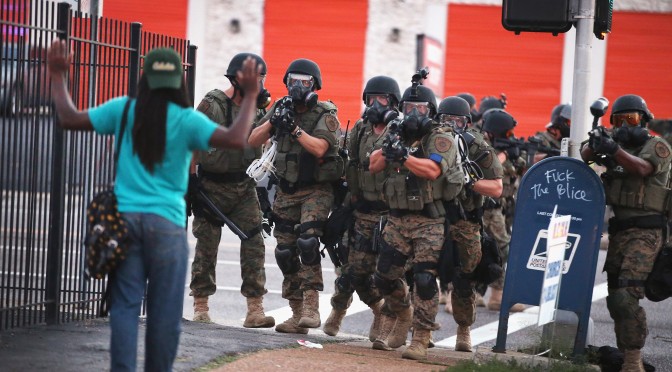
American Apartheid: Discrimination Disguised as Law

On Monday, June 20, 2016, the United States moved even closer to a police state when the U.S. Supreme Court ruled in Utah v. Strieff that evidence of a crime may be used against a defendant even if the police did something wrong or illegal in obtaining it. Black people have been complaining about unconstitutional searches for decades and now the Supreme Court has partially nullified fourth amendment protection for everyone against illegal searches.

The laws of the United States including federal or state statutes and local ordinance have been designed to suppress black people. There have been a number of laws specifically enacted to enslave, control movement, miseducate, and prevent the economic progress of black people. The CIA allowed drugs to be imported into black communities during the 1990s. During the Civil Rights Movement, the FBI had a secret program called COINTELPRO to discredit and disrupt civil rights leaders and protest. See U.S. Government Discrimination

Before the United States became a country, the colonies enacted slave codes to ensure that slaves had no rights and could be treated as property. This country supposedly conceived in liberty, defined black slaves as less than human in the constitution, the Supreme Law of the United States. 

Last month, I became disgusted the day I read a British Broadcasting Corporation (BBC) article about how information from the CIA led to Nelson Mandela's arrest and his 27-year imprisonment in 1962. See: Nelson Mandela: CIA tip-off led to 1962 Durban arrest. Even though Nelson Mandela was president of South Africa from 1994 to 1999, he was on a US terror watch list until 2008, the same year Barack Obama was elected president. I felt a similar disgust when I learned of the Supreme Court's decision.

Justice Sonia Sotomayor, a former criminal prosecutor, dissented the US Supreme Court's decision and warned that people of color are the subject of particular scrutiny. “This court has given officers an array of instruments to probe and examine you,” she added. “When we condone officers’ use of these devices without adequate cause, we give them reason to target pedestrians in an arbitrary manner. We also risk treating members of our communities as second-class citizens.

Justice Sotomayor specifically cited the St. Louis area when she stated, "In the St. Louis metropolitan area, officers “routinely” stop people—on the street, at bus stops, or even in court—for no reason other than “an officer’s desire to check whether the subject had a municipal arrest warrant pending.”"

Justice Sotomayor's full dissent is published below.


JUSTICE SOTOMAYOR, with whom JUSTICE GINSBURG joins as to Parts I, II, and III, dissenting

The Court today holds that the discovery of a warrant for an unpaid parking ticket will forgive a police officer’s violation of your Fourth Amendment rights. Do not be soothed by the opinion’s technical language: This case allows the police to stop you on the street, demand your identification, and check it for outstanding traffic warrants—even if you are doing nothing wrong. If the officer discovers a warrant for a fine you forgot to pay, courts will
now excuse his illegal stop and will admit into evidence anything he happens to find by searching you after arresting you on the warrant. Because the Fourth Amendment should prohibit, not permit, such misconduct, I dissent.

I

Minutes after Edward Strieff walked out of a South Salt Lake City home, an officer stopped him, questioned him, and took his identification to run it through a police database. The officer did not suspect that Strieff had done anything wrong. Strieff just happened to be the first person to leave a house that the officer thought might contain “drug activity.” App. 16–19. As the State of Utah concedes, this stop was illegal. App. 24. The Fourth Amendment protects people from “unreasonable searches and seizures.” An officer breaches that protection when he detains a pedestrian to check his license without any evidence that the person is engaged in a crime. Delaware v. Prouse, 440 U. S. 648, 663 (1979); Terry v. Ohio, 392 U. S. 1, 21 (1968). The officer deepens the breach when he prolongs the detention just to fish further for evidence of wrongdoing. Rodriguez v. United States, 575 U. S. ___, ___–___ (2015) (slip op., at 6–7). In his search for lawbreaking, the officer in this case himself broke the law. The officer learned that Strieff had a “small traffic warrant.” App. 19. Pursuant to that warrant, he arrested Strieff and, conducting a search incident to the arrest,
discovered methamphetamine in Strieff ’s pockets. Utah charged Strieff with illegal drug possession. Before trial, Strieff argued that admitting the drugs into evidence would condone the officer’s misbehavior. The methamphetamine, he reasoned, was the product of the officer’s illegal stop. Admitting it would tell officers that unlawfully discovering even a “small traffic warrant” would give them license to search for evidence of unrelated offenses. The Utah Supreme Court unanimously agreed with Strieff. A majority of this Court now reverses.

II

It is tempting in a case like this, where illegal conduct by an officer uncovers illegal conduct by a civilian, to forgive the officer. After all, his instincts, although unconstitutional, were correct. But a basic principle lies at the heart of the Fourth Amendment: Two wrongs don’t make a right. See Weeks v. United States, 232 U. S. 383, 392 (1914). When “lawless police conduct” uncovers evidence of lawless civilian conduct, this Court has long required later criminal trials to exclude the illegally obtained evidence.Terry, 392 U. S., at 12; Mapp v. Ohio, 367 U. S.643, 655 (1961). For example, if an officer breaks into a home and finds a forged check lying around, that check may not be used to prosecute the homeowner for bank fraud. We would describe the check as “‘fruit of the poisonous tree.’” Wong Sun v. United States, 371 U. S. 471, 488 (1963). Fruit that must be cast aside includes not only evidence directly found by an illegal search but also evidence “come at by exploitation of that illegality.” Ibid. This “exclusionary rule” removes an incentive for officers to search us without proper justification. Terry, 392 U. S., at 12. It also keeps courts from being “made party to lawless invasions of the constitutional rights of citizens by permitting unhindered governmental use of the fruits of such invasions.” Id., at 13. When courts admit only lawfully obtained evidence, they encourage “those who formulate law enforcement polices, and the officers who implement them, to incorporate Fourth Amendment ideals into their value system.” Stone v. Powell, 428 U. S. 465, 492 (1976). But when courts admit illegally obtained evidence as well, they reward “manifest neglect if not an open defiance of the prohibitions of the Constitution.” Weeks, 232 U. S., at 394.Applying the exclusionary rule, the Utah Supreme Court correctly decided that Strieff ’s drugs must be excluded because the officer exploited his illegal stop to discover them. The officer found the drugs only after learning of Strieff ’s traffic violation; and he learned of Strieff ’s traffic violation only because he unlawfully stopped Strieff to check his driver’s license. The court also correctly rejected the State’s argument that the officer’s discovery of a traffic warrant unspoiled the poisonous fruit. The State analogizes finding the warrant to one of our earlier decisions, Wong Sun v. United States. There, an officer illegally arrested a person who, days later, voluntarily returned to the station to confess to committing a crime. 371 U. S., at 491. Even though the person would not have confessed “but for the illegal actions of the police,” id., at 488, we noted that the police did not exploit their illegal arrest to obtain the confession, id., at 491. Because the confession was obtained by “means sufficiently distinguishable” from the constitutional violation, we held that it could be admitted into evidence. Id., at 488, 491. The State contends that the search incident to the warrant-arrest here is similarly distinguishable from the illegal stop. But Wong Sun explains why Strieff ’s drugs must be excluded. We reasoned that a Fourth Amendment violation may not color every investigation that follows but it certainly stains the actions of officers who exploit the infraction. We distinguished evidence obtained by innocuous means from evidence obtained by exploiting misconduct after considering a variety of factors: whether a long time passed, whether there were “intervening circumstances,” and whether the purpose or flagrancy of the misconduct was “calculated” to procure the evidence. Brown v. Illinois, 422 U. S. 590, 603–604 (1975). These factors confirm that the officer in this case discovered Strieff ’s drugs by exploiting his own illegal conduct. The officer did not ask Strieff to volunteer his name only to find out, days later, that Strieff had a warrant against him. The officer illegally stopped Strieff and immediately ran a warrant check. The officer’s discovery of a warrant was not some intervening surprise that he could not have anticipated. Utah lists over 180,000 misdemeanor warrants in its database, and at the time of the arrest, Salt Lake County had a “backlog of outstanding warrants” so large that it faced the “potential for civil liability.” See Dept. of Justice, Bureau of Justice Statistics, Survey of State Criminal History Information Systems, 2014 (2015) (Systems Survey) (Table 5a), online at 

https://www.ncjrs.gov/pdffiles1/bjs/grants/249799.pdf

(all Internet materials as last visited June 16, 2016); Inst.for Law and Policy Planning, Salt Lake County Criminal Justice System Assessment 6.7 (2004), online at

http://www.slco.org/cjac/resources/SaltLakeCJSAfinal.pdf

The officer’s violation was also calculated to procure evidence. His sole reason for stopping Strieff, he acknowledged, was investigative—he wanted to discover whether drug activity was going on in the house Strieff had just exited. App. 17. The warrant check, in other words, was not an “intervening circumstance” separating the stop from the search for drugs. It was part and parcel of the officer’s illegal “expedition for evidence in the hope that something might turn up.” Brown, 422 U.S., at 605. Under our precedents, because the officer found Strieff ’s drugs by exploiting his own constitutional violation, the drugs should be excluded.

III

A

The Court sees things differently. To the Court, the fact that a warrant gives an officer cause to arrest a person severs the connection between illegal policing and the resulting discovery of evidence. Ante, at 7. This is a remarkable proposition: The mere existence of a warrant not only gives an officer legal cause to arrest and search a person, it also forgives an officer who, with no knowledge of the warrant at all, unlawfully stops that person on a whim or hunch.To explain its reasoning, the Court relies on Segura v.United States, 468 U. S. 796 (1984). There, federal agents applied for a warrant to search an apartment but illegally entered the apartment to secure it before the judge issued the warrant. Id., at 800–801. After receiving the warrant, the agents then searched the apartment for drugs. Id., at
801. The question before us was what to do with the evidence the agents then discovered. We declined to suppress it because “[t]he illegal entry into petitioners’ apartment did not contribute in any way to discovery of the evidence seized under the warrant.” Id., at 815. According to the majority, Segura involves facts “similar” to this case and “suggest[s]” that a valid warrant will clean up whatever illegal conduct uncovered it. Ante, at 6–7. It is difficult to understand this interpretation. In Segura, the agents’ illegal conduct in entering the apartment had nothing to do with their procurement of a search warrant. Here, the officer’s illegal conduct in stopping Strieff was essential to his discovery of an arrest warrant.
Segura would be similar only if the agents used information they illegally obtained from the apartment to procure a search warrant or discover an arrest warrant. Precisely because that was not the case, the Court admitted the untainted evidence. 468 U. S., at 814.The majority likewise misses the point when it calls the warrant check here a “‘negligibly burdensome precautio[n]’” taken for the officer’s “safety.” Ante, at 8 (quoting Rodriguez, 575 U. S., at ___ (slip op., at 7)). Remember, the officer stopped Strieff without suspecting him of committing any crime. By his own account, the officer did not fear Strieff. Moreover, the safety rationale we discussed in Rodriguez, an opinion about highway patrols, is conspicuously absent here. A warrant check on a highway “ensur[es] that vehicles on the road are operated safely and responsibly.” Id., at ___ (slip op., at 6). We allow such checks during legal traffic stops because the legitimacy of a person’s driver’s license has a “close connection to roadway safety.” Id., at ___ (slip op., at 7). A warrant check of
a pedestrian on a sidewalk, “by contrast, is a measure aimed at ‘detect[ing] evidence of ordinary criminal wrongdoing.’” Ibid. (quoting Indianapolis v. Edmond, 531 U. S. 32, 40–41 (2000)). Surely we would not allow officers to warrant-check random joggers, dog walkers, and lemonade vendors just to ensure they pose no threat to anyone else. The majority also posits that the officer could not have exploited his illegal conduct because he did not violate the Fourth Amendment on purpose. Rather, he made “good­faith mistakes.” Ante, at 8. Never mind that the officer’s sole purpose was to fish for evidence. The majority casts his unconstitutional actions as “negligent” and therefore incapable of being deterred by the exclusionary rule. Ibid. But the Fourth Amendment does not tolerate an officer’s
unreasonable searches and seizures just because he did not know any better. Even officers prone to negligence can learn from courts that exclude illegally obtained evidence.Stone, 428 U. S., at 492. Indeed, they are perhaps the most in need of the education, whether by the judge’s opinion, the prosecutor’s future guidance, or an updated manual on criminal procedure. If the officers are in doubt about what the law requires, exclusion gives them an “incentive to err on the side of constitutional behavior.” United States v. Johnson, 457 U. S. 537, 561 (1982).

B

Most striking about the Court’s opinion is its insistence that the event here was “isolated,” with “no indication that this unlawful stop was part of any systemic or recurrent police misconduct.” Ante, at 8–9. Respectfully, nothing about this case is isolated. Outstanding warrants are surprisingly common. When a person with a traffic ticket misses a fine payment or court appearance, a court will issue a warrant. See, e.g., Brennan Center for Justice, Criminal Justice Debt 23 (2010), online at

https://www.brennancenter.org/sites/default/files/legacy/Fees%20and%20Fines%20FINAL.pdf.

When a person on probation drinks alcohol or breaks curfew, a court will issue a warrant. See, e.g., Human Rights Watch, Profiting from Probation 1, 51 (2014), online at 

https://www.hrw.org/report/2014/02/05/profiting-probation/ americas-offender-funded-probation-industry.

The States and Federal Government maintain databases with over 7.8 million outstanding warrants, the vast majority of which appear to be for minor offenses. See Systems Survey (Table 5a). Even these sources may not track the “staggering” numbers of warrants, “‘drawers and drawers’” full, that many cities issue for traffic violations and ordinance infractions. Dept. of Justice, Civil Rights Div., Investigation of the Ferguson Police Department 47, 55 (2015) (Ferguson Report), online at

https://www.justice.gov/ sites/default/files/opa/press-releases/attachments/2015/03/
04/ferguson_police_department_report.pdf
.

The county in this case has had a “backlog” of such warrants. See supra, at 4. The Department of Justice recently reported that in the town of Ferguson, Missouri, with a population of 21,000, 16,000 people had outstanding warrants against them. Ferguson Report, at 6, 55. Justice Department investigations across the country have illustrated how these astounding numbers of warrants can be used by police to stop people without cause.In a single year in New Orleans, officers “made nearly 60,000 arrests, of which about 20,000 were of people with outstanding traffic or misdemeanor warrants from neighboring parishes for such infractions as unpaid tickets.” Dept. of Justice, Civil Rights Div., Investigation of the New Orleans Police Department 29 (2011), online at 

https://www.justice.gov/sites/default/files/crt/legacy/2011/03/17/nopd_report.pdf.

In the St. Louis metropolitan area, officers “routinely” stop people—on the street, at bus stops, or even in court—for no reason other than “an officer’s desire to check whether the subject had a municipal arrest warrant pending.” Ferguson Report, at 49, 57. In Newark, New Jersey, officers stopped 52,235 pedestrians within a 4-year period and ran warrant checks on 39,308 of them. Dept. of Justice, Civil Rights Div., Investigation of the Newark Police Department 8, 19, n. 15 (2014), online at

https://www.justice.gov/sites/default/files/crt/legacy/2014/07/22/newark_findings_7-22-14.pdf

The Justice Department analyzed these warrant-checked stops and reported that “approximately 93% of the stops would have been considered unsupported by articulated reasonable suspicion.” Id., at 9, n. 7. I do not doubt that most officers act in “good faith” and do not set out to break the law. That does not mean these stops are “isolated instance[s] of negligence,” however. Ante, at 8. Many are the product of institutionalized training procedures. The New York City Police Department long trained officers to, in the words of a District Judge, “stop and question first, develop reasonable suspicion later.” Ligon v. New York, 925 F. Supp. 2d 478, 537–538 (SDNY), stay granted on other grounds, 736 F. 3d 118 (CA2 2013). The Utah Supreme Court described as “‘routine procedure’ or ‘common practice’” the decision of Salt Lake City police officers to run warrant checks on pedestrians they detained without reasonable suspicion. State v. Topanotes, 2003 UT 30, ¶2, 76 P. 3d 1159, 1160. In the related context of traffic stops, one widely followed police manual instructs officers looking for drugs to “run at least a warrants check on all drivers you stop. Statistically, narcotics offenders are . . . more likely to fail to appear on simple citations, such as traffic or trespass violations, leading to the issuance of bench warrants. Discovery of an outstanding warrant gives you cause for an immediate custodial arrest and search of the suspect.” C. Remsberg, Tactics for Criminal Patrol 205–206 (1995); C.Epp et al., Pulled Over 23, 33–36 (2014). The majority does not suggest what makes this case “isolated” from these and countless other examples. Nor does it offer guidance for how a defendant can prove that his arrest was the result of “widespread” misconduct. Surely it should not take a federal investigation of Salt Lake County before the Court would protect someone in Strieff ’s position.

IV

Writing only for myself, and drawing on my professional experiences, I would add that unlawful “stops” have severe consequences much greater than the inconvenience suggested by the name. This Court has given officers an array of instruments to probe and examine you. When we condone officers’ use of these devices without adequate cause, we give them reason to target pedestrians in an arbitrary manner. We also risk treating members of our communities as second-class citizens.Although many Americans have been stopped for speeding or jaywalking, few may realize how degrading a stop can be when the officer is looking for more. This Court has allowed an officer to stop you for whatever reason he wants—so long as he can point to a pretextual justification after the fact. Whren v. United States, 517 U. S. 806, 813 (1996). That justification must provide specific reasons why the officer suspected you were breaking the law, Terry, 392 U. S., at 21, but it may factor in your ethnicity, United States v. Brignoni-Ponce, 422 U. S. 873, 886–887 (1975), where you live, Adams v. Williams, 407 U. S. 143, 147 (1972), what you were wearing, United States v. Sokolow, 490 U. S. 1, 4–5 (1989), and how you behaved, Illinois v. Wardlow, 528 U. S. 119, 124–125 (2000). The officer does not even need to know which law you might have broken so long as he can later point to any possible infraction—even one that is minor, unrelated, or ambiguous. Devenpeck v. Alford, 543 U. S. 146, 154–155 (2004); Heien v. North Carolina, 574 U. S. ___ (2014). The indignity of the stop is not limited to an officer telling you that you look like a criminal. See Epp, Pulled Over, at 5. The officer may next ask for your “consent” to inspect your bag or purse without telling you that you can decline. See Florida v. Bostick, 501 U. S. 429, 438 (1991). Regardless of your answer, he may order you to stand “helpless, perhaps facing a wall with [your] hands raised.” Terry, 392 U. S., at 17. If the officer thinks you might be dangerous, he may then “frisk” you for weapons. This involves more than just a pat down. As onlookers pass by, the officer may “‘feel with sensitive fingers every portion of [your] body. A thorough search [may] be made of [your] arms and armpits, waistline and back, the groin and area about the testicles, and entire surface of the legs down to the feet.’” Id., at 17, n. 13. The officer’s control over you does not end with the stop. If the officer chooses, he may handcuff you and take you to jail for doing nothing more than speeding, jaywalking, or “driving [your] pickup truck . . . with [your] 3-year-old son and 5-year-old daughter . . . without [your] seatbelt fastened.” Atwater v. Lago Vista, 532 U. S. 318, 323–324 (2001). At the jail, he can fingerprint you, swab DNA from the inside of your mouth, and force you to “shower with a delousing agent” while you “lift [your] tongue, hold out [your] arms, turn around, and lift [your] genitals.” Florence v. Board of Chosen Freeholders of County of Burlington, 566 U. S. ___, ___–___ (2012) (slip op., at 2–3); Maryland v. King, 569 U. S. ___, ___ (2013) (slip op., at 28). Even if you are innocent, you will now join the 65 million Americans with an arrest record and experience the “civil death” of discrimination by employers, landlords, and whoever else conducts a background check. Chin, The New Civil Death, 160 U. Pa. L. Rev. 1789, 1805 (2012); see J. Jacobs, The Eternal Criminal Record 33–51 (2015); Young & Petersilia, Keeping Track, 129 Harv. L. Rev. 1318, 1341–1357 (2016). And, of course, if you fail to pay bail or appear for court, a judge will issue a warrant to render you “arrestable on sight” in the future. A. Goffman, On the Run 196 (2014). This case involves a suspicionless stop, one in which the officer initiated this chain of events without justification. As the Justice Department notes, supra, at 8, many innocent people are subjected to the humiliations of these unconstitutional searches. The white defendant in this case shows that anyone’s dignity can be violated in this manner. See M. Gottschalk, Caught 119–138 (2015). But it is no secret that people of color are disproportionate victims of this type of scrutiny. See M. Alexander, The New Jim Crow 95–136 (2010). For generations, black and brown parents have given their children “the talk”— instructing them never to run down the street; always keep your hands where they can be seen; do not even think of talking back to a stranger—all out of fear of how an officer with a gun will react to them. See, e.g., W. E. B. Du Bois, The Souls of Black Folk (1903); J. Baldwin, The Fire Next Time (1963); T. Coates, Between the World and Me (2015).

By legitimizing the conduct that produces this double consciousness, this case tells everyone, white and black, guilty and innocent, that an officer can verify your legal status at any time. It says that your body is subject to invasion while courts excuse the violation of your rights. It implies that you are not a citizen of a democracy but the subject of a carceral state, just waiting to be cataloged. We must not pretend that the countless people who are routinely targeted by police are “isolated.” They are the canaries in the coal mine whose deaths, civil and literal, warn us that no one can breathe in this atmosphere. See L. Guinier & G. Torres, The Miner’s Canary 274–283 (2002). They are the ones who recognize that unlawful police stops corrode all our civil liberties and threaten all our lives. Until their voices matter too, our justice system will continue to be anything but.
* * *
 I dissent.

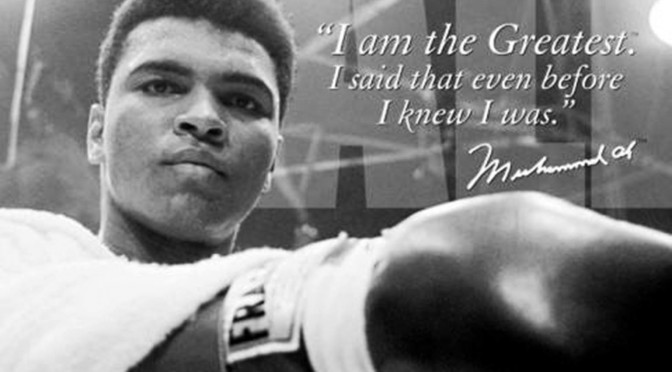
Muhammad Ali’s Memorial Service – Tributes of Greatness

Dr. Kevin Cosby set the tone and delivered an outstanding and fitting eulogy to Muhammad Ali.

My brother and uncle attended the Muhammad Ali memorial service in Louisville yesterday. Unfortunately, I was unable to attend, but I was able to watch it thanks to Bounce TV's live coverage. Bounce TV is majority owned and operated by African Americans. We need more stations like Bounce to overcome the racial bias of white media.

World leaders, stars and regular people from all over the world of all faiths and stations in life were inspired and in awe of Mr. Ali's greatness not as a boxing champion, but as a person and humanitarian. Muhammad Ali's memorial included speakers of many religious faiths. Rabbi Michael Lerner's eulogy was a remarkable example of Ali inspired activism.

Lonnie Ali, Muhammad Ali's wife, displayed tremendous poise and strength with her remarkable tribute to her husband.

As I watched Muhammad Ali's memorial service, I couldn't help but be reminded of all the other great inspiring American Black men and women who transcended their circumstances or professions and helped changed the world such as Frederick Douglass, Mary McLeod Bethune, Booker T. Washington, A. Philip Randolph, Ida B. Wells, Dorothy Height, W.E.B. Dubois, Jessie Owens, Jackie Robinson, Medgar Evers, Malcolm X, Martin Luther King, Rosa Parks, Maya Angelo, Harry Belafonte, Michael Jackson, Thurgood Marshall, Paul Robeson, Barack Obama, St. Louisans (Annie Malone, Frankie Muse Freeman, my uncle Dick Gregory) and many others. As a people, we are capable of amazing feats and humanity, especially considering the history of our circumstance.

Billy Crystal Eulogy Speech at Muhammad Ali Memorial Funeral:

Bill Clinton Delivers Eulogy at Ali Funeral FULL Speech

Although, President Barack Obama couldn't attend the funeral of Muhammad Ali because his daughter was graduating the day of the funeral, President Obama paid a moving tribute.

Use Ali's example of intelligence, wisdom, courage, humility, and humanity to inspire you to see through the lies of history and stand up for yourself and others.

See our post, "Muhammad Ali: Humanity's Champion

When you have nothing, you have nothing to lose

Political leaders, police and news media always seem to be perplexed about violent crime, especially when it happens in unexpected areas. The recent incidents of criminal activity in downtown St. Louis prompted people to ask why some seem to have so little regard for others.

Mayor Slay pledged a crackdown on downtown St. Louis crime, but didn't promise a similar crackdown on crime in other areas. It's as if crime happening in other areas was unimportant or as if suddenly people are now committing illegal acts, but only in areas that matter. Evidently, murders and other crime that occur in some neighborhoods are less urgent than others.

Poverty and crime are related. The United Nations and the World Bank acknowledge poverty, oppression, inequality and lack of economic opportunities results in increased criminal activity. When inequalities are great, crime goes through the roof. When people see vast wealth differences, especially if the wealth disparity is based on injustice, crime becomes even worse. People who have nothing, often feel they have nothing to lose and they aren't that concerned about what others have to lose. 

Before heroin addiction became an epidemic in white middle-class communities, drug addicts, especially black ones were treated as criminals which increased the vicious nature of some crimes. Factor in poverty and drug addiction and increased criminal activity is easy to understand. Common sense tells me that since drug addiction has increased in white communities, crime has already increased or will soon. Those white drug addicts consider their drug of choice a necessity and will do anything to get them. Drug distribution networks that government and law enforcement allowed to flourish during the black crack epidemic are now fully entrenched to supply the white heroin epidemic. Ironically, most of the black heroin addicts that I have learned about recently lived in predominately white communities.

The FBI ranks St. Louis as the top US city for violent crime. St. Louis was ranked as one of the most segregated and the third poorest city with a population over 200,000 in the United States. The City of St. Louis has a legacy of racism and corruption that has contributed to poverty and current crime problems. Ferguson should have been a wake-up call for the region, instead the St. Louis City Police Chief coined the phrase "Ferguson Effect", to indicated increased crime was caused by those complaining about oppression.

The entire St. Louis Region appears to be in denial about racial and economic injustice and oppression. St. Louis has the Delmar Divide, a street that divides communities by race which gained international attention a few years ago. St. Louis has a reputation of being a racist city. In the short documentary film, "Racism in St. Louis", one film creator explained that even a homeless man in New York mentioned how racist St. Louis was.

Many of the U.S. Supreme Court Decisions concerning St. Louis involved racial issues including the Dred Scott Case which was one of the major issues leading the country to Civil War. In fact, in 1847, William W. Brown stated, "no part of our slave-holding country, is more noted for the barbarity of its inhabitants, than St. Louis". Racial restrictive covenants were struck down by the U.S. Supreme Court in the St. Louis case of Shelley vs Kraemer.

Even the standard test of racial employment discrimination by the U.S. Supreme Court was created in the St. Louis case of Green vs McDonnell Douglass. Until St. Louis takes steps to correct past injustices, this city and region will continue to decline. 

Maslow's Hierarchy of Needs Theory

Just about every college student learns about a motivational theory developed by Abraham Maslow in the 1940's. His theory is taught in a variety of subjects including education, psychology, business management and marketing.

Abraham Maslow's hierarchy of needs theory proposed that motivation is the result of a person's attempt at fulfilling five basic needs: physiological, safety, social, esteem and self-actualization.

Physiological needs are those needs required for human survival such as air, food, water, shelter, clothing and sleep. A person will do just about anything to meet these needs; including violent crime.This doesn't mean that only poor people commit crimes, but the motivation for committing those crimes are different.  

People of means often commit crimes of greed, so-called "white-collar crime".

White collar crime is usually financially motivated, nonviolent crime committed by business and government professionals such as bribery, kickbacks, corruption, fraud, embezzlement, insider trading and a variety of other crimes. These are not victimless crimes. A single scam can destroy a company, devastate families by wiping out their life savings, or cost investors billions of dollars (or even all three). Today’s fraud schemes are more sophisticated than ever. 

Poor people often commit crimes of need, based on perceived necessity or survival. 

When a person can't feed himself or his family and can't find work what do you think they'll do? Starve? No, depending on their level of desperateness, they will do whatever is necessary. Some will borrow, some will seek public assistance if they qualify or beg, others will steal. Some time ago, the media was reporting how theft of Tide laundry detergent had dramatically increased and most recently, a shoplifter was shot trying to steal steaks and toilet paper. Those people were stealing food and other basic need items.

Many people facing hunger or homelessness believe they have nothing to lose, and nothing is more dangerous to society than a person who has nothing to lose. St. Louis needs to start addressing the causes of crime instead of just reacting to it. 

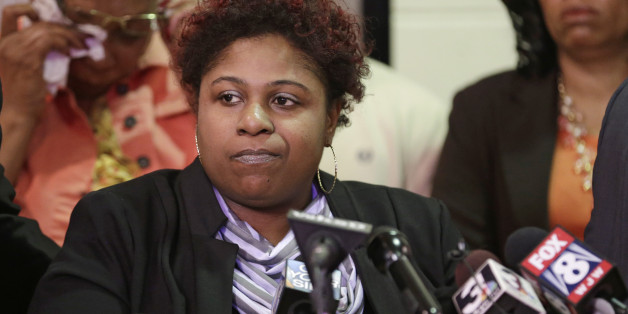
Tamir Rice’s Mother – No Candidate Endorsement

Why I Have Not Endorsed Any Candidate

Reflections from a Mom of the Movement
by Samaria Rice

Reprinted in Support of her fight for justice.

Over the past few weeks, I had been approached by many people all with the same question: Who will I endorse for President of the United States? I have heard this even more since the launch of the Justice For Tamir Speak Out Tour. I have watched as my fellow mothers that have lost children have chosen a candidate to invest their faith in and I support them in their pursuits of justice for their children, and the people want to know where I stand.

For over a year I have been fighting for justice for my son, Tamir , who was killed by Cleveland police officers Timothy Loehmann and Frank Garmback. For over a year, I’ve waited to see if any candidate or official, including my state’s governor, would release a plan of action that addressed the failures and inhumane decisions responsible for my son’s death. While I’ve waited, I’ve been speaking out for true action, with changes that would help prevent another tragedy like Tamir’s murder, changes that truly hold these police accountable and give people power in the communities we live in.

As a resident of Cleveland, Ohio, my local and state governments have not only failed my family, they’ve caused us severe trauma. After shooting Tamir, Cleveland police neglected to call aid for my son and handcuffed my daughter, who was trying help her brother. Then the city of Cleveland later tried to charge me for the ambulance ride that was too late to save my son’s life. They said it was a mistake, and no one was held responsible for any of pain they caused my family.

After Tamir’s death, the county prosecutor, Timothy McGinty, an elected official, responsible for seeking justice for Tamir, instead blamed my 12 year old boy for his own death.

NOTE: Timothy McGinty, the Cleveland prosecutor who cleared cops in Tamir Rice’s death was defeated in primary


All of this happened under the administration of Ohio governor, John Kasich, a 2016 presidential nominee. Ohio’s state government has shown me repeatedly that the people elected to serve have no interest in justice. The loss of Tamir has made it clear to me that Cleveland is deeply invested in a system of injustice. No one has been held responsible for any part of this entire traumatic experience. No one has at least apologized for killing my son. Not a single politician has offered me some substantial support.

While I’ve continued to push my state’s officials towards real changes, several Presidential candidates have said my son’s name in their mouth, using his death as an example of what shouldn’t happen in America. Twelve year old children should never be murdered for playing in a park. But not a single politician: local, state or federal, has taken action to make sure it doesn’t happen again.

Instead of plans for justice and accountability, I have been shown several plans for criminal justice reform, none that address my experience of the entire system being guilty. Those plans don’t address the many ways elected officials become exempt to accountability and the legal flaws that allow them to extend that exemption to cops who kill. These plans do not get rid of the trauma of knowing that my tax dollars help pay the salaries of the police officers that killed my son.

As one of the Mothers of the Movement, I know the death of Tamir has shown many just how important police accountability is. I also know it must be a piece of a larger plan to address the deep corruptions that exist in America. The people should be the ones determining what accountability looks like, not prosecutors who work closely with police to deny the people justice. County Prosecutors whose job requires them to believe the police the majority of the time, should not be the same people prosecuting them. Police officers often lie about fearing for their life.

True community oversight of the police is one that evens the balance of power and allows the communities police serve to judge how well they are doing their job. My experience has let me know that the system is working just the way the people in power want it to. That is why I refuse to accept plans or support politicians that offer what they propose as solutions, not informed by us, the community. It’s why I won’t accept plans for more “community police” as positive solutions when it was the police that killed my son. I cannot settle for partial solutions and lip service. I know we need real action, and I refuse to endorse any candidate that offers less.

MLK Day and St. Louis’ first murder of the year

I didn't attend any ceremonies, speeches or marches this Martin Luther King holiday. Instead, I attended the funeral of the first murder victim in the City of St. Louis, Markel Simms.

On January 8th, I wrote a two sentence editorial beneath the headline, on the news page,  announcing St. Louis' first murder of the year. Two days later, I discovered that the murder victim was my nephew's cousin. My nephew, who lives in California, was devastated when he got the news. His brother was killed almost twenty years ago on the same street.

Markel was 35 years old, married and the father of four children. The pastor who eulogized Markel was a police officer with the Homicide, Ministers & Community Alliance (HMCA), a group founded to assist families as they cope with the homicide of a loved one; originally authorized by former police chief Dan Isom. It was refreshing to know that the St. Louis Police Department had such a program. Protect and serve was in full effect today.

The pastor describe how the worst sound in the world is that of a mother upon seeing her child's body at a murder scene, a sight he acknowledged, he has experience much too often. He reminded everyone that all life is precious and warned against the dangers of  vengeance and retribution. He also mentioned how most of St. Louis' murder victims are mostly young black men and women and how most of those murdered were killed by someone they knew. He cautioned those in attendance to mind the company they kept.

I couldn't help but think about the tragedy of attending a funeral of a murdered young black man on Martin Luther King Day. As I listened to the pastor's eulogy, I couldn't help but think about what King might say.

The ultimate weakness of violence is that it is a descending spiral,
begetting the very thing it seeks to destroy.
Instead of diminishing evil, it multiplies it.
Through violence you may murder the liar,
but you cannot murder the lie, nor establish the truth.
Through violence you may murder the hater,
but you do not murder hate.
In fact, violence merely increases hate.
So it goes.
Returning violence for violence multiplies violence,
adding deeper darkness to a night already devoid of stars.
Darkness cannot drive out darkness:
only light can do that.
Hate cannot drive out hate: only love can do that.

Dr. Martin Luther King, Jr.

At the funeral today, I saw people who I have known for years, some for most of my life who I never knew had a connection to Markel or one of his family members and I was reminded how interconnected we all are.

What happens in a person's mind when they decide that a particular person's life no longer matters and decides to end it? Do they ever consider the fact that they may be killing the brother of their future wife? Do they consider that life may be a relative of a close friend? Do they think about all the other lives that will be impacted?

As I made my parting view of Markel, I thought to myself how a part of King's dream had died with Markel and with all the other murder victims, past and future. Help keep King's dream alive.

Help someone lift up someone else. If you can help a neighbor, co-worker or even a stranger, do it! It could be as simple as giving advice about how or what to do. Young black men killing each other is a symptom of the diseases of poverty, hopelessness, marginalization and negative self imagery. If you can help cure just one person, you will have made a tremendous difference and helped keep the dream alive!

My Dungeon Shook

Hours after I attended Markel's funeral, Chris Rock read James Baldwin's letter to his nephew, "My Dungeon Shook", during a tribute at the "MLK Now" event in Harlem honoring the late Martin Luther King.

Although this letter was written in 1963, it describes the challenges faced by young black men all across America and is still unfortunately true and timely.

MY DUNGEON SHOOK
LETTER TO MY NEPHEW ON THE ONE HUNDREDTH ANNIVERSARY OF THE EMANICIPATION
by James Baldwin

Dear James:

I have begun this letter five times and torn it up five times. I keep seeing your face, which is also the face of your father and my brother. Like him, you are tough, dark, vulnerable, mood—with a very definite tendency to sound truculent because you want no one to think you are soft. You may be like your grandfather in this, I don’t know, but certainly both you and your father resemble him very much physically. Well, he is dead, he never saw you, and he had a terrible life; he was defeated long before he died because, at the bottom of his heart, he really believed what white people said about him. This is one of the reasons that he became so holy. I am sure that your father has told you something about all that. Neither you nor your father exhibit any tendency towards holiness: you really are of another era, part of what happened when the late E. Franklin Frazier called “the cities of destruction.” You can only be destroyed by believing that you really are what the white world calls a nigger. I tell you this because I love you, and please don’t forget it.

I have known both of you all your lives, have carried your Daddy in my arms and on my shoulders, kissed and spanked him and watched him learn to walk. I don’t know if you’ve known anybody from that far back; if you’ve loved anybody that long, first as an infant, then as a child, then as a man, you gain a strange perspective on time and human pain and effort. Other people cannot see what I see whenever I look into your father’s face as it is today are all those other faces which were his. Let him laugh and I see a cellar your father does not remember and a house he does not remember and I hear in his present laughter his laughter as a child. Let him curse and I remember him falling down the cellar steps, and howling, and I remember, with pain, his tears, which my hand or your grandmother’s so easily wiped away. But no one’s hand can wipe away those tears he sheds invisibly today, which one hears in his laughter and in his speech and in his songs. I know what the world has done to my brother and how narrowly he has survived it. And I know, which is much worse, and this is the crime of which I accuse my country and my countrymen, and for which neither I nor time nor history will ever forgive them, that they have destroyed and are destroying hundreds of thousands of lives and do not know it and do not want to know it. One can be, indeed one must strive to become, tough and philosophical concerning destruction and death, for this is what most of mankind has been best at since we have heard of man. (But remember: most of mankind is not all of mankind.) But it is not permissible that the authors of devastation should also be innocent. It is the innocence which constitutes the crime.

Now, my dear namesake, these innocent and well-meaning people, your countrymen, have caused you to be born under conditions not very far removed from those described for us by Charles Dickens in the London of more than a hundred years ago. (I hear the chorus of the innocents screaming, “No! This is not true! How bitter you are!”—but I am writing this letter to you, to try to tell you something about how to handle them, for most of them do not yet really know that you exist. I know the conditions, under which you were born, for I was there. Your countrymen were not there, and haven’t made it yet. Your grandmother was also there, and no one has ever accused her of being bitter. I suggest that the innocents check with her. She isn’t hard to find. Your countrymen don’t know that she exists, either, though she has been working for them all their lives.)
Well, you were born, here you came, something like fourteen years ago: and though your father and mother and grandmother, looking about the streets through which they were carrying you, staring at the walls into which they brought you, had every reason to be heavyhearted, yet they were not. For here you were, Big James, named for me—you were a big baby, I was not—here you were: to be loved. To be loved, baby, hard, at once, and forever, to strengthen you against the loveless world. Remember that: I know how black it looks today, for you. It looked bad that day, too, yes, we were trembling. We have not stopped trembling yet, but if we had not loved each other none of us would have survived. And now you must survive because we love you, and for the sake of your children and your children’s children.

This innocent country set you down in a ghetto in which, in fact, it intended that you should perish. Let me spell out precisely what I mean by that, for the heart of the matter is here, and the root of my dispute with my country. You were born where you were born, and faced the future that you faced because you were black and for no other reason. The limits of your ambition were, thus, expected to be set forever. You were born into a society which spelled out with brutal clarity, and in as many ways as possible, that you were a worthless human being. You were not expected to aspire to excellence: you were expected to make peace with mediocrity.

Wherever you have turned, James, in your short time on this earth , you have been told where you could go and what you could do (and how you could do it) and where you could do it and whom you could marry. I know that your countrymen do not agree with me about this, and I hear them saying “You exaggerate.” They do not know Harlem, and I do. So do you. Take no one’s word for anything, including mine—but trust your experience. Know whence you came. If you know whence your came, there is really no limit to where you can go. The details and symbols of your life have been deliberately constructed to make you believe what white people say about you. Please try to remember that what that believe, as well as what they do and cause you to endure, does not testify to your inferiority but to their inhumanity and fear. Please try to be clear, dear James, though the storm which rages about your youthful head today, about the reality which lies behind the words acceptance and integration. There is no reason for you to try to become like white people and there is no basis whatever for their impertinent assumption that they must accept you.

The really terrible thing, old buddy, is that you must accept them. And I mean that very seriously. You must accept them and accept them with love. For these innocent people have no other hope. They are, in effect, still trapped in a history which they do not understand; and until they understand it, they cannot be released from it. They have had to believe for so many years, and for innumerable reasons, that black men are inferior to white men. Many of them, indeed, know better, but, as you will discover, people find it very difficult to act on what they know. To act is to be committed, and to be committed is to be in danger. In this case, the danger, in the minds of most white Americans, is the loss of identity. Try to imagine how you would feel if you woke up one morning to find the sun shinning and all the stars aflame. You would be frightened because it is our of the order of nature. Any upheaval in the universe is terrifying because it so profoundly attacks one’s sense of one’s own reality. Well, the black man has functioned in the white man’s world as a fixed star, as an immovable pillar: and as he moves out of his place, heaven and earth are shaken to their foundations.

You, don’t be afraid. I said that it was intended that you should perish in the ghetto, perish by never being allowed to go behind the white man’s definitions, by never being allowed to spell your proper name. You have, and many of us have, defeated this intention; and, by a terrible law, a terrible paradox, those innocents who believed that your imprisonment made them safe are losing their grasp of reality. But these men are your brothers—your lost, younger brothers. And if the word integration means anything, this is what it means: that we, with love, shall force our brothers to see themselves as they are, to cease fleeing from reality and begin to change it.

For this is your home, my friend, do not be driven from it; great men have done great things here, and will again, and we can make America what America must become. It will be hard, James, but you come from sturdy, peasant stock, men who picked cotton and dammed rivers and built railroads, and in the teeth of the most terrifying odds, achieved and unassailable and monumental dignity. You come from a long line of poets, some of the greatest poets since Homer. One of them said, The very time I thought I was lost, My dungeon shook and my chains fell off.

You know, and I know, that the country is celebrating one hundred years of freedom one hundred years too soon. We cannot be free until they are free. God bless you, James, and Godspeed.

Your uncle,
James

First They Came

"If you are neutral in situations of injustice, you have chosen the side of the oppressor. If an elephant has its foot on the tail of a mouse and you say that you are neutral, the mouse will not appreciate your neutrality". – – Desmond Tutu

First they came for Black men, and I did not speak out —
Because I was not Black.

Then they came for the Muslims, and I did not speak out—
Because I was not a Muslim.

"First they came …" is a famous statement and provocative poem written by Pastor Martin Niemöller (1892–1984) about the cowardice of German intellectuals following the Nazis' rise to power and the subsequent purging of their chosen targets, group after group.

The United States Holocaust Memorial Museum quotes the following text as one of the many poetic versions of the speech:


First they came for the Socialists, and I did not speak out—
Because I was not a Socialist.

Then they came for the Trade Unionists, and I did not speak out—
Because I was not a Trade Unionist.

Then they came for the Jews, and I did not speak out—
Because I was not a Jew.

Then they came for me—and there was no one left to speak for me.


White Lives Matter Too!

A White man died from injuries suffered while in St. Louis City jail. The homeless man was arrested for trespassing. The man's mother believes police beat her son and told a reporter that she and family members were shocked when they saw Gilbert’s body at the morgue. “He’s black and blue and swollen all over,” she told a reporter Wednesday. “It just blew our mind when they pulled the curtain back. I wanted them to pull the sheet further down because we wanted to see his full body. They killed our kid. My husband went nuts. We knew immediately that this was no head injury or wrestling around — no, they beat him.”

During an event that took place earlier this year in Washington, MO, a White man was tasered while handcuffed, but in his case the incident was captured on video. The police officer has since been fired and Washington, MO paid an undisclosed amount in settlement of a lawsuit.

People and organizations such as Black Lives Matter are not imagining police brutality, it does happen.  It's just a matter of time before the injustices people remain silent about, visits them.  "All that is necessary for the triumph of evil is that good men do nothing."

60th Anniversary of Montgomery Bus Boycott

Today mark the 60th anniversary of the spark that ignited the the Montgomery Bus Boycott and the civil rights protest movement.

On December 1, 1955, in Montgomery, Alabama, Rosa Parks refused to obey bus driver James F. Blake's order to give up her seat in the colored section to a white passenger, after the white section was filled. Parks was not the first person to resist bus segregation.

Rosa Louise McCauley Parks, February 4, 1913 – October 24, 2005, was known as "the first lady of civil rights" and "the mother of the freedom movement". Parks' act of defiance and the Montgomery Bus Boycott became important symbols of the modern Civil Rights Movement. She became an international icon of resistance to racial segregation.

Rosa Parks – Quiet Revolutionary – The Documentary

Rest in peace "Mother Parks".

Long History of Police Brutality

Since the inception of policing, police brutality has existed. Policing in the United States has been primarily concerned with the protection of property and began in the early 1600's with slave patrols. During labor movements in the late 1800's and early 1900's, police brutalized workers fighting for decent wages, working conditions and the right to unionize.

Minneapolis – November 2015

Police shootings of unarmed people and incidents of police abusing their authority have provided glaring examples of rampant police brutality. Most recently, a Minneapolis police officer shot an unarmed black man whom several witnesses claim was handcuffed.

Beginning with the civil rights movement in the 1950's and 1960's, police brutality reached new heights and recently incidents of police brutality have been frequently captured on video; a few examples are below.

Malcolm X

More than 50 years ago, Malcolm X stated: “the police commissioner feeds the type of statistics to the white public to make them think that Harlem is a complete criminal area where everyone is prone towards violence. This gives the police the impression that they can then go and brutalize the Negroes, or suppress the Negroes, or even frighten the Negroes.”

“This force that is so visible in the Harlem community it creates a spirit of resentment in every Negro. They think they are living in a police state, and they become hostile toward the policemen. They think that the policeman is there to be against them rather than to protect them. And these thoughts, these frustrations, these apparitions, automatically are sufficient to make these Negroes begin to form means and ways to protect themselves in case the police themselves get too far out of line.”

Malcolm X could make the same argument today about Ferguson, New York, Baltimore or any number of cities or recent incidents.

Watts Riots

On August 11, 1965, a black driver, Marquette Frye, was arrested for drunk-driving, the driver's mother, Rena Price, got involved and Mr. Frye, a passenger, and Ms. Price were arrested. The treatment by the police caused anger to onlookers. Rumors spread that the police had roughed Frye up and kicked a pregnant woman; angry mobs formed and the situation escalated and suddenly turned into a riot.

The second night of the riots, my uncle, comedian and civil rights activist, Dick Gregory tried to calm down the crowds, he was shot in the leg. Mr. Gregory, who was born and raised in St. Louis, discusses the incident below and makes a very interesting observation about police brutality.

Thirty-four people were killed, and more than 1,000 injured, during the riots that lasted six days.

Black Panthers

In October of 1966, the Black Panther Party for Self Defense was created in response to challenge police brutality in Oakland, California and their movement spread across the country.  The original purpose was to arm black men to patrol their neighborhoods and monitor the behavior of police officers.  In 1969, community social programs, including free breakfast for children, and community health clinics became core activities of Black Panther Party members.

Black Panther membership peaked in 1970, with offices in 68 cities and thousands of members.

Huey P. Newton Gun Club

The Huey P. Newton Gun Club has formed in South Dallas, Texas utilizing the state's open carry law to patrol their neighborhood in the spirit of the Black Panthers. The group was started by two former Army Rangers and they have begun drills and training others in self-defense. See article for addition information.

The movie Panther (1995) portrays the Black Panther Party for Self-Defense, tracing the organization from its founding through its decline. Creative license is taken but the general trajectory of the Party and its experiences is factual.

Rodney King – Los Angeles Riot

In 1991, the first videotaped incident of police brutality went viral. The beating of Rodney King by Los Angeles police was broadcast worldwide and clearly showed Los Angeles police engaged in excessive force and a Los Angeles grand jury indicted four of the police officers.

The California Court of Appeals granted a change of venue to the city of Simi Valley, citing potential contamination due to saturated media coverage. Simi Valley was predominantly white and the jury consisted of 10 white members and no black jurors.

All four white officers involved were acquitted on April 29, 1992, and people began rioting after the verdict was given, resulting in over 2,000 injuries, 53 deaths and nearly $1 billion in financial losses. The riots ended when the California national guard was called in.  The riots resulted in federal civil rights prosecution and two of the four officers were convicted and imprisoned.

Sister Souljah, a raptivist, appeared on an episode of Bill Cosby's "A Different World", and expressed sentiments held by many; which still ring true today.

The Issue Is Race

Months after the verdict in the Rodney King case and riots in Los Angele, Phil Donahue hosted a PBS special, "The Issue Is Race: A Crisis in Black and White". It's disheartening to watch this show from more than 20 years ago because many of the exact same issues are still major problems today.

Slavery Back in Effect

Slavery was so profitable that it fueled the wealth and independence that made the United States a world power. This country that describes itself as the land of the free has never fully made good on that promise. During the last decade of slavery, slaves seeking freedom were given the diagnosis of Drapetomania,  a supposed mental illness,which caused black slaves to flee captivity.

After the Civil War, and the North's abandonment of reconstruction, a new form of oppression, Jim Crow, created conditions not far removed from slavery.  According to legal scholar Michelle Alexander’s best-selling book "The New Jim Crow: Mass Incarceration in the Age of Colorblindness", there are more Black men under some form of correctional supervision (incarceration or probation) now than were enslaved prior to the Civil War.

In 1995, Sister Souljah released the video, "Final Solution: Slavery Back in Effect", which imagines a police state where blacks fight against the re-institution of slavery; the video was banned by MTV.

Sister Souljah during an interview about the Rodney King/ LA Uprisings that occurred earlier that year was quoted as saying ‘If Black people kill Black people every day, why not have a week and kill white people?’.. her remarks were connected to a much longer response and in full context makes sense, but isolated subjected her to criticism. Sister Souljah provided a jarring response to Governor Bill Clinton's negative comments about her in 1992 made while he was running for president.

School Psychology Weaponized

Mental diagnosis is once again being used against black students. African American students are disproportionately represented in special education. 85% of all special education students receive drugs. African American males are only 3% of the public school population, yet they make up 30% of students separated from the “normal” students in school by placement into special education. See Dr. Umar Johnson, a nationally known school psychologist, comments about black children in special education.

The labeling of these students is sabotaging and endangering their education, destroying futures and leading to increased mass incarceration; the last form of legalized slavery.

Policing without deadly force

Somehow police in other countries can successfully capture suspects wielding weapons without resorting to deadly force.

UK man with a knife is taken down by a couple of police officers with pepper spray and police clubs.

A black man with knife captured in London by police using a taser. This man would have certainly been killed in the United States.

Below a man with a machete, who appears to be under the influence of drugs is taken down by police alive using plastic riot shields.

The fact that so many police officers were devoted to capturing the man with the machete may seem like a waste of manpower, however, in the U.S., when a person is killed by police; a similar number of officers often arrive at the scene and remain much longer processing the scene, logging evidence, and crowd control.

UK Traffic Cops Arrest Suspect Trying to Run Away

The video camera is our greatest weapon against police brutality. Police unions across the country are fighting body cameras, so the question must be posed; what is it they don't want people seeing? Continue pressing your alderman, mayor and other politicians for mandatory police body cameras. Record encounters you witness of police, use ACLU mobile app. You never know when the next innocent victim will be you, your child, friend or neighbor!

St. Louis Arch’s Golden Anniversary

Today, October 28, 2015, marks the 50th anniversary, that the capstone, which was the last triangular section of the St. Louis Arch, was set in place. The building of the Arch was a monumental feat of engineering. Speeches will be given about the great spirit, engineering and effort that went into the building of the Arch.

The history of the building of the Arch will be retold. The first stainless steel sections of the Arch arrived at the site where the foundation had already been prepared on February 12, 1963, construction began, and the final steel section of the Gateway Arch was placed on October 28, 1965.

Percy Green and Richard Daley on the St. Louis Arch, July 14, 1964

There is a part of that history that is often overlooked or excluded. Civil rights activists at the time regarded the construction of the Arch as a token of racial discrimination.  The Construction Company building the Arch, MacDonald Construction Co. of St. Louis, employed about 1,000 workers. MacDonald Construction did not use any black contractors and none of their employees were black. The writers of history often removed portions they prefer forgotten.

The February 2013 video below , an episode of City Corner, discusses St Louis Civil Rights Activities with Percy Green. His involvement in with the Arch protest is shown at the 17:34 mark.

On July 14, 1964, during the Arch workers' lunchtime, civil rights protesters Percy Green and Richard Daly, both members of Congress of Racial Equality (C.O.R.E.), climbed up 125-feet on the north leg of the arch to "expose the fact that federal funds were being used to build a national monument that was racially discriminating against black contractors and skilled black workers." As the pair disregarded demands to get off, protesters on the ground demanded that at least 10% of the skilled jobs belong to African Americans.


Percy Green and the McDonnell Douglass Test

Some of the same exclusionary tactics used during the construction of the St. Louis Arch, unfortunately, still seem very familiar today. During Percy Green's reflection upon those days prior to the Arch protest, he mentioned how bright students were reduced to criminal activity because of the lack of opportunity. That same lack of opportunity results in higher crime rates today.

His actions at the Arch set in motion events that would result in a Landmark Supreme Court decision affecting the entire nation.


Percy Green was a black mechanic and laboratory technician, and was laid off by McDonnell Douglas in 1964 shortly after the Arch protest, during a reduction in force at the company. Percy Green protested that his discharge was racially motivated. He and others, used cars to block roads to McDonnell Douglas factories. On one occasion, someone used a chain to lock the front door of a McDonnell Douglas downtown business office, preventing employees from leaving, though it was not certain whether Green was responsible.

McDonnell Douglas advertised for vacant mechanic positions, for which Green was qualified. Green applied, but was not hired, with McDonnell Douglas citing his participation in blocking traffic and chaining the building.

Green filed a complaint with the Equal Employment Opportunity Commission (EEOC), which resulted in a unanimous (9-0) Supreme Court's decision in Mr. Green's favor.

The case: McDonnell Douglas Corp. v. Green, 411 US 792 – Supreme Court 1973, created of a framework or ("test") for Title VII cases where there is only relatively indirect evidence as to whether an employment action was discriminatory in nature.

Mcdonnell Douglas test requires an employer to prove with evidence showing that the employment action complained was taken for nondiscriminatory reasons. However, the employee must show the following conditions are satisfied:

1.The plaintiff (employee) must establish a prima facie case of discrimination;

2.The defendant (employer) must produce evidence of a legitimate non-discriminatory reason for its actions. If this occurs, then the presumption of discrimination becomes invalid;

3.The plaintiff (employee) must present facts to show an inference of discrimination.